Ch 25: The Electric Potential
Knight Calc - Physics for Scientists and Engineers 5th Edition
Knight Calc5th EditionPhysics for Scientists and EngineersISBN: 9780137344796당신이 사용하는 게 아니라요?교과서 변경
25장, 문제 38a

A −10.0 nC point charge and a +20.0 nC point charge are 15.0 cm apart on the x-axis. What is the electric potential at the point on the x-axis where the electric field is zero?

검증된 단계별 안내
1
Step 1: Understand the problem. The electric field is zero at a point where the contributions from both charges cancel each other out. This point is not necessarily the midpoint between the charges because the magnitudes of the charges are different. Use the principle of superposition to find this point.
Step 2: Set up the equation for the electric field. The electric field due to a point charge is given by \( E = \frac{k \cdot q}{r^2} \), where \( k \) is Coulomb's constant, \( q \) is the charge, and \( r \) is the distance from the charge. At the point where the electric field is zero, the magnitudes of the electric fields from both charges are equal: \( \frac{k \cdot q_1}{r_1^2} = \frac{k \cdot q_2}{r_2^2} \).
Step 3: Solve for the distance \( r_1 \) and \( r_2 \). Let \( r_1 \) be the distance from the −10.0 nC charge to the point where the electric field is zero, and \( r_2 \) be the distance from the +20.0 nC charge to the same point. Since the charges are 15.0 cm apart, \( r_1 + r_2 = 15.0 \, \text{cm} \). Substitute \( r_2 = 15.0 \, \text{cm} - r_1 \) into the equation from Step 2.
Step 4: Calculate the electric potential at the point where the electric field is zero. The electric potential due to a point charge is given by \( V = \frac{k \cdot q}{r} \). At the point where the electric field is zero, the potentials from both charges add algebraically: \( V = \frac{k \cdot q_1}{r_1} + \frac{k \cdot q_2}{r_2} \). Use the values of \( r_1 \) and \( r_2 \) found in Step 3 to calculate the potential.
Step 5: Verify the solution conceptually. Ensure that the electric field is indeed zero at the calculated point and that the electric potential is consistent with the principle of superposition. This step helps confirm the correctness of the approach and the calculations.

비슷한 문제에 대한 검증된 영상 답변:

이 영상 해법은 위 문제에 도움이 된다고 튜터들이 추천한 것입니다.

주요 개념

질문에 올바르게 답하기 위해 반드시 이해해야 하는 핵심 개념들은 다음과 같습니다.

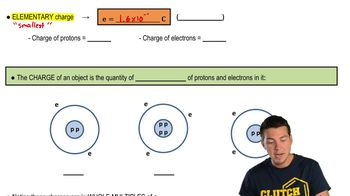
Electric Charge

Electric charge is a fundamental property of matter that causes it to experience a force when placed in an electromagnetic field. Charges can be positive or negative, with like charges repelling and opposite charges attracting each other. In this problem, we have a negative charge (-10.0 nC) and a positive charge (+20.0 nC), which will influence the electric field and potential in their vicinity.
추천 영상:
가이드 코스
05:37
Electric Charge

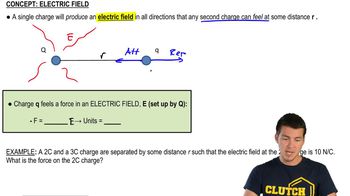
Electric Field

The electric field is a vector field that represents the force exerted by an electric charge on other charges in its vicinity. It is defined as the force per unit charge and points away from positive charges and towards negative charges. In this scenario, the electric field created by the two point charges will determine the location along the x-axis where the net electric field is zero, which is crucial for solving the problem.
추천 영상:
가이드 코스
03:16
Intro to Electric Fields

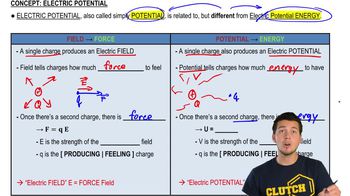
Electric Potential

Electric potential, often referred to as voltage, is the work done per unit charge in bringing a charge from infinity to a point in an electric field. It is a scalar quantity and can be calculated for point charges using the formula V = k * (q/r), where k is Coulomb's constant, q is the charge, and r is the distance from the charge. Understanding electric potential is essential for determining the potential at the point where the electric field is zero in this problem.
추천 영상:
가이드 코스
07:33
Electric Potential