Ch 26: Potential and Field
Knight Calc - Physics for Scientists and Engineers 5th Edition
Knight Calc5th EditionPhysics for Scientists and EngineersISBN: 9780137344796당신이 사용하는 게 아니라요?교과서 변경
26장, 문제 12

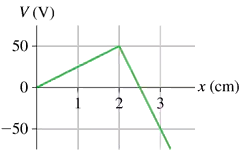
FIGURE EX26.12 is a graph of V versus x. Draw the corresponding graph of Ex versus x.
Graph showing voltage (V) in volts versus position (x) in centimeters, with a peak at 2 cm and a downward trend thereafter.

검증된 단계별 안내
1
Step 1: Understand the relationship between electric potential (V) and electric field (E). The electric field is the negative gradient of the electric potential, mathematically expressed as \( E_x = -\frac{dV}{dx} \). This means the electric field is the rate of change of the potential with respect to position.
Step 2: Analyze the graph of \( V \) versus \( x \). Look at the slope of the graph at different points. The slope of the \( V \) graph corresponds to \( \frac{dV}{dx} \), which will determine the value of \( E_x \). If the slope is positive, \( E_x \) will be negative, and if the slope is negative, \( E_x \) will be positive.
Step 3: Identify regions where the slope is zero, positive, or negative. For example, if the \( V \) graph is flat (horizontal), \( \frac{dV}{dx} = 0 \), and \( E_x \) will be zero in that region. If the \( V \) graph is increasing, \( \frac{dV}{dx} > 0 \), and \( E_x \) will be negative. If the \( V \) graph is decreasing, \( \frac{dV}{dx} < 0 \), and \( E_x \) will be positive.
Step 4: Sketch the \( E_x \) versus \( x \) graph based on the slopes of the \( V \) graph. For each region of the \( V \) graph, translate the slope into the corresponding value of \( E_x \). Ensure that the sign of \( E_x \) matches the direction of the slope (negative for increasing \( V \), positive for decreasing \( V \)).
Step 5: Label the axes of the \( E_x \) graph properly. The x-axis remains the same as in the \( V \) graph, while the y-axis now represents \( E_x \). Ensure the graph reflects the correct magnitude and direction of \( E_x \) based on the analysis of the \( V \) graph.

비슷한 문제에 대한 검증된 영상 답변:

이 영상 해법은 위 문제에 도움이 된다고 튜터들이 추천한 것입니다.
도움이 되었나요?

주요 개념

질문에 올바르게 답하기 위해 반드시 이해해야 하는 핵심 개념들은 다음과 같습니다.

Electric Field (Ex)

The electric field (Ex) is a vector field that represents the force per unit charge experienced by a positive test charge placed in the field. It is defined as the negative gradient of the electric potential (V), meaning that the electric field points in the direction of decreasing potential. Understanding this relationship is crucial for converting a potential graph into an electric field graph.
추천 영상:
가이드 코스
03:16
Intro to Electric Fields

Gradient

In physics, the gradient is a mathematical operation that describes the rate and direction of change in a quantity. For a function like electric potential (V), the gradient indicates how steeply the potential changes with respect to position (x). In the context of electric fields, the gradient of V gives the electric field strength and direction, which is essential for accurately drawing the Ex versus x graph.

Graph Interpretation

Interpreting graphs involves understanding the relationship between the variables plotted on the axes. In this case, the graph of V versus x provides information about how potential changes with position, which can be translated into the electric field graph. Recognizing features such as slopes and intercepts in the V versus x graph is key to accurately depicting the corresponding Ex versus x graph.
추천 영상:
가이드 코스
07:32
Graphing Position, Velocity, and Acceleration Graphs