Ch 26: Potential and Field
Knight Calc - Physics for Scientists and Engineers 5th Edition
Knight Calc5th EditionPhysics for Scientists and EngineersISBN: 9780137344796당신이 사용하는 게 아니라요?교과서 변경
26장, 문제 14

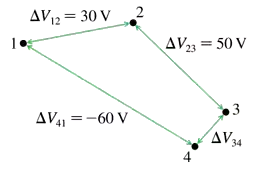
What is the potential difference ΔV34 in FIGURE EX26.14?
Diagram showing four points connected by arrows with potential differences labeled, asking for the potential difference ΔV34.

검증된 단계별 안내
1
Step 1: Identify the components in FIGURE EX26.14 that are relevant to calculating the potential difference ΔV34. Typically, this involves analyzing the circuit elements (e.g., resistors, batteries) and their arrangement between points 3 and 4.
Step 2: Apply Kirchhoff's Voltage Law (KVL), which states that the sum of the potential differences around any closed loop in a circuit is zero. Write an equation for the loop that includes points 3 and 4.
Step 3: Determine the direction of current flow and the polarity of each component (e.g., resistors cause a voltage drop, batteries contribute a voltage rise). Use Ohm's Law, \( V = IR \), for resistors if needed.
Step 4: Sum the potential differences across all components between points 3 and 4. Include contributions from batteries and resistors, ensuring you account for their polarities correctly.
Step 5: Simplify the equation to find the potential difference ΔV34. This will be the net voltage change between points 3 and 4.

비슷한 문제에 대한 검증된 영상 답변:

이 영상 해법은 위 문제에 도움이 된다고 튜터들이 추천한 것입니다.
도움이 되었나요?

주요 개념

질문에 올바르게 답하기 위해 반드시 이해해야 하는 핵심 개념들은 다음과 같습니다.

Electric Potential Difference

Electric potential difference, or voltage, is the work done per unit charge in moving a charge between two points in an electric field. It is measured in volts (V) and indicates how much energy is available to move charges through a circuit. Understanding this concept is crucial for analyzing circuits and determining how energy is distributed among components.
추천 영상:
가이드 코스
07:33
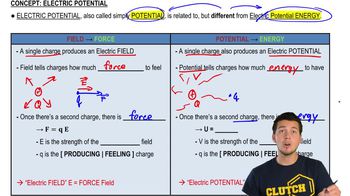
Electric Potential

Circuit Analysis

Circuit analysis involves applying principles of electricity to understand how current flows through a circuit and how voltage is distributed across its components. Techniques such as Ohm's Law, Kirchhoff's laws, and the use of series and parallel combinations are essential for solving problems related to potential differences in circuits.
추천 영상:
가이드 코스
05:00
Dimensional Analysis

Reference Points in Electric Circuits

In electric circuits, reference points are essential for measuring potential differences. Typically, one point is chosen as a reference (often ground), and the potential at other points is measured relative to this reference. This concept is vital for accurately determining the voltage between two points, such as ΔV34 in the given question.
추천 영상:
가이드 코스
14:10
Inertial Reference Frames