
You've decided to protect your house by placing a 5.0-m-tall iron lightning rod next to the house. The top is sharpened to a point and the bottom is in good contact with the ground. From your research, you've learned that lightning bolts can carry up to 50 kA of current and last up to 50 μs. You don't want the potential difference between the top and bottom of the lightning rod to exceed 100 V. What minimum diameter must the rod have?
Ch 27: Current and Resistance
27장, 문제 75
A 300 μF capacitor is charged to 9.0 V, then connected in parallel with a 5000 Ω resistor. The capacitor will discharge because the resistor provides a conducting pathway between the capacitor plates, but much more slowly than if the plates were connected by a wire. Let t=0 s be the instant the fully charged capacitor is first connected to the resistor. At what time has the capacitor voltage decreased by half, to 4.5 V?
검증된 단계별 안내1
Identify the key components of the problem: The capacitor has a capacitance \( C = 300 \mu F = 300 \times 10^{-6} \; F \), the resistor has a resistance \( R = 5000 \; \Omega \), and the initial voltage across the capacitor is \( V_0 = 9.0 \; V \). The goal is to find the time \( t \) when the voltage across the capacitor decreases to \( V = 4.5 \; V \).
Recall the formula for the voltage across a discharging capacitor in an RC circuit: \( V(t) = V_0 e^{-t / \tau} \), where \( \tau = RC \) is the time constant of the circuit. Here, \( \tau \) represents the time it takes for the voltage to decrease to approximately 36.8% of its initial value.
Calculate the time constant \( \tau \): Substitute \( R = 5000 \; \Omega \) and \( C = 300 \times 10^{-6} \; F \) into the formula \( \tau = RC \). This gives \( \tau = 5000 \times 300 \times 10^{-6} \; s \).
Set up the equation for the voltage at time \( t \): Substitute \( V(t) = 4.5 \; V \), \( V_0 = 9.0 \; V \), and the expression for \( \tau \) into the formula \( V(t) = V_0 e^{-t / \tau} \). This gives \( 4.5 = 9.0 e^{-t / \tau} \).
Solve for \( t \): Divide both sides of the equation by \( 9.0 \), resulting in \( 0.5 = e^{-t / \tau} \). Take the natural logarithm of both sides to isolate \( t \): \( \ln(0.5) = -t / \tau \). Rearrange to find \( t \): \( t = -\tau \ln(0.5) \). Substitute the value of \( \tau \) calculated earlier to determine \( t \).

비슷한 문제에 대한 검증된 영상 답변:
이 영상 해법은 위 문제에 도움이 된다고 튜터들이 추천한 것입니다.
도움이 되었나요?
주요 개념
질문에 올바르게 답하기 위해 반드시 이해해야 하는 핵심 개념들은 다음과 같습니다.
Capacitance
Capacitance is the ability of a capacitor to store charge per unit voltage, measured in farads (F). In this scenario, the 300 μF capacitor can store a significant amount of charge at 9.0 V. The capacitance determines how much energy can be stored and how quickly it can be released when connected to a circuit.
추천 영상:
가이드 코스
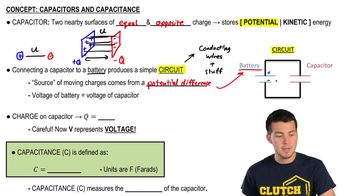
Capacitors & Capacitance (Intro)
RC Time Constant
The RC time constant, denoted as τ (tau), is a measure of the time it takes for the voltage across a capacitor to either charge or discharge to approximately 63.2% of its maximum value. It is calculated as τ = R × C, where R is the resistance in ohms and C is the capacitance in farads. This concept is crucial for understanding how quickly the capacitor voltage decreases over time.
추천 영상:
가이드 코스
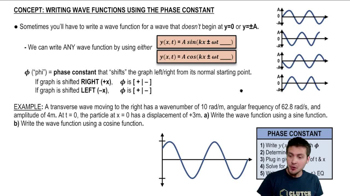
Phase Constant of a Wave Function
Exponential Decay
Exponential decay describes the process by which the voltage across a discharging capacitor decreases over time, following the equation V(t) = V0 * e^(-t/τ). Here, V0 is the initial voltage, e is the base of the natural logarithm, and t is time. This concept helps in determining the specific time at which the voltage drops to half its initial value, which is essential for solving the given problem.
추천 영상:
가이드 코스
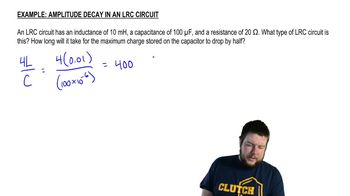
Amplitude Decay in an LRC Circuit
관련 실천
교과서 질문
70
views
교과서 질문
A 2.0-mm-diameter wire formed from a composite material has a resistivity that decreases with distance along the wire as ρ=ρ₀e−αx, where ρ₀=4.0×10⁻⁵ Ω m, x (in m) is measured from one end of the wire, and the constant α=4.0 m−1. What is the resistance of a 50-cm-long length of this wire?
2013
views
교과서 질문
Two 10-cm-diameter metal plates 1.0 cm apart are charged to ±12.5 nC. They are suddenly connected together by a 0.224-mm-diameter copper wire stretched taut from the center of one plate to the center of the other. Does the current increase with time, decrease with time, or remain steady? Explain.
42
views
