Ch 27: Current and Resistance
Knight Calc - Physics for Scientists and Engineers 5th Edition
Knight Calc5th EditionPhysics for Scientists and EngineersISBN: 9780137344796당신이 사용하는 게 아니라요?교과서 변경
27장, 문제 1

The electron drift speed in a 1.0-mm-diameter gold wire is 5.0 x 10⁻⁵ m/s. How long does it take 1 mole of electrons to flow through a cross section of the wire?

검증된 단계별 안내
1
Determine the cross-sectional area of the wire using the formula for the area of a circle: A=πr^2, where the radius r is half the diameter. Convert the diameter of 1.0 mm to meters before calculating.
Calculate the current density J using the drift velocity formula: J=nevd, where n is the number density of conduction electrons in gold, e is the elementary charge, and vd is the drift velocity. Look up the number density of conduction electrons for gold.
Find the total charge carried by 1 mole of electrons using Avogadro's number NA and the elementary charge e. The total charge is given by Q=NAe.
Relate the current I to the drift velocity using the formula I=JA, where J is the current density and A is the cross-sectional area of the wire.
Calculate the time it takes for 1 mole of electrons to flow through the cross section of the wire using the formula t=Q/I, where Q is the total charge and I is the current.

비슷한 문제에 대한 검증된 영상 답변:

이 영상 해법은 위 문제에 도움이 된다고 튜터들이 추천한 것입니다.
도움이 되었나요?

주요 개념

질문에 올바르게 답하기 위해 반드시 이해해야 하는 핵심 개념들은 다음과 같습니다.

Drift Speed

Drift speed refers to the average velocity that a charge carrier, such as an electron, attains due to an electric field in a conductor. It is typically much slower than the speed of the electric signal in the wire, as it represents the net movement of electrons in the direction of the electric field. Understanding drift speed is crucial for calculating how quickly charge can flow through a conductor.
추천 영상:
가이드 코스
07:59
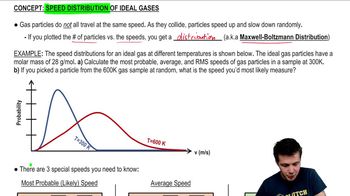
Speed Distribution & Special Speeds of Ideal Gases

Current

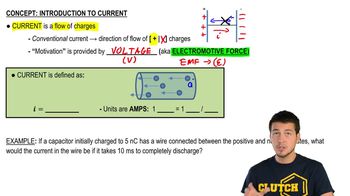
Current is the rate of flow of electric charge in a circuit, measured in amperes (A). It can be calculated using the formula I = nAvq, where n is the charge carrier density, A is the cross-sectional area, and q is the charge of an electron. Knowing the current allows us to determine how long it takes for a specific amount of charge, such as 1 mole of electrons, to pass through a given cross-section of the wire.
추천 영상:
가이드 코스
05:38
Intro to Current

Mole of Electrons

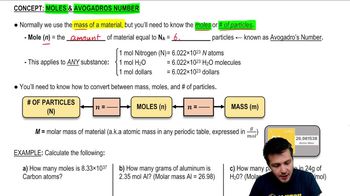
A mole of electrons refers to Avogadro's number (approximately 6.022 x 10²³), which quantifies the number of particles in one mole of a substance. In the context of electric charge, one mole of electrons carries a total charge of about -96,485 coulombs. This concept is essential for converting between the number of electrons and the total charge when calculating the time required for that charge to flow through a conductor.
추천 영상:
가이드 코스
07:19
Moles & Avogadro's Number