Ch 27: Current and Resistance
Knight Calc - Physics for Scientists and Engineers 5th Edition
Knight Calc5th EditionPhysics for Scientists and EngineersISBN: 9780137344796당신이 사용하는 게 아니라요?교과서 변경
27장, 문제 57b

The resistivity of a metal increases slightly with increased temperature. This can be expressed as ρ=ρ₀[1+α(T−T₀)] , where T₀ is a reference temperature, usually 20°C, and α is the temperature coefficient of resistivity. For copper, α=3.9×10⁻³ °C−1. Suppose a 2.5-m-long, 0.40-mm-diameter copper wire is connected across the terminals of a 1.5 V ideal battery. What is the current in the wire at 20°C?

검증된 단계별 안내
1
Step 1: Start by identifying the given values in the problem. The resistivity equation is ρ = ρ₀[1 + α(T − T₀)], where T = 20°C, T₀ = 20°C, and α = 3.9×10⁻³ °C⁻¹. Since T = T₀, the term α(T − T₀) becomes zero, so ρ = ρ₀. For copper, the resistivity at 20°C (ρ₀) is approximately 1.68×10⁻⁸ Ω·m.
Step 2: Calculate the cross-sectional area of the wire. The diameter of the wire is given as 0.40 mm, so the radius r = 0.40 mm / 2 = 0.20 mm = 0.20 × 10⁻³ m. The cross-sectional area A of the wire is given by A = πr². Substitute the radius into this formula to find A.
Step 3: Use the formula for resistance R = ρL/A, where L is the length of the wire (2.5 m), ρ is the resistivity (1.68×10⁻⁸ Ω·m), and A is the cross-sectional area calculated in Step 2. Substitute the values to calculate the resistance R of the wire.
Step 4: Apply Ohm's Law to find the current in the wire. Ohm's Law states that I = V/R, where V is the voltage (1.5 V) and R is the resistance calculated in Step 3. Substitute the values to calculate the current I.
Step 5: Verify the units and ensure all calculations are consistent. The final current I will be in amperes (A), as the voltage is in volts (V) and resistance is in ohms (Ω).

비슷한 문제에 대한 검증된 영상 답변:

이 영상 해법은 위 문제에 도움이 된다고 튜터들이 추천한 것입니다.
도움이 되었나요?

주요 개념

질문에 올바르게 답하기 위해 반드시 이해해야 하는 핵심 개념들은 다음과 같습니다.

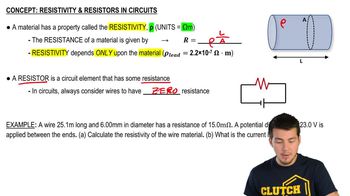
Resistivity

Resistivity is a material property that quantifies how strongly a given material opposes the flow of electric current. It is denoted by the symbol ρ and is influenced by factors such as temperature. In metals, resistivity typically increases with temperature due to increased atomic vibrations that impede electron flow.
추천 영상:
가이드 코스
05:25
Resistivity & Resistors in Circuits

Ohm's Law

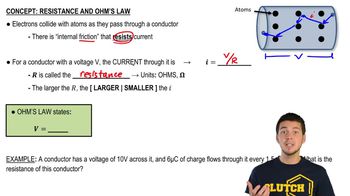
Ohm's Law states that the current (I) flowing through a conductor between two points is directly proportional to the voltage (V) across the two points and inversely proportional to the resistance (R) of the conductor. It is mathematically expressed as V = IR. This fundamental principle is essential for calculating current in electrical circuits.
추천 영상:
가이드 코스
03:07
Resistance and Ohm's Law

Temperature Coefficient of Resistivity

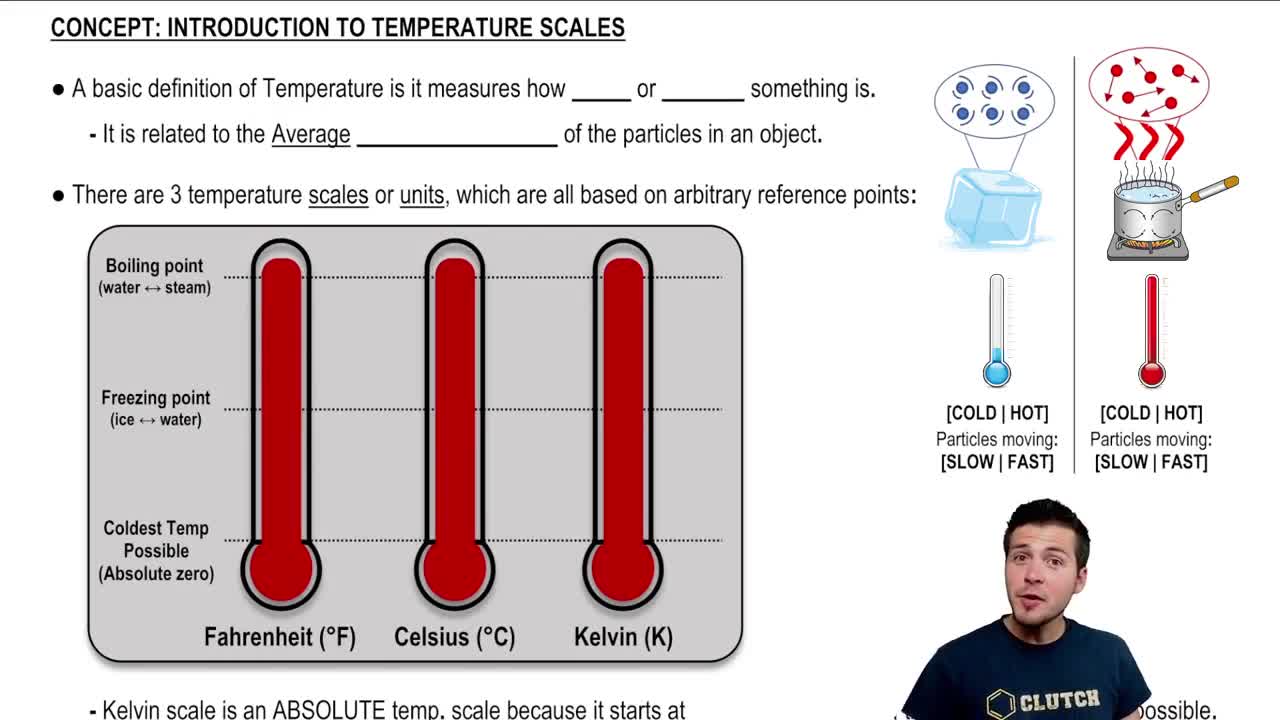
The temperature coefficient of resistivity (α) is a parameter that quantifies how much the resistivity of a material changes with temperature. For copper, α is approximately 3.9×10⁻³ °C⁻¹, indicating that for each degree Celsius increase in temperature, the resistivity increases by this fraction. This concept is crucial for understanding how temperature variations affect electrical properties in conductors.
추천 영상:
가이드 코스
04:54
Introduction To Temperature Scales
관련 실천