
Ch 27: Current and Resistance
Knight Calc - Physics for Scientists and Engineers 5th Edition
Knight Calc5th EditionPhysics for Scientists and EngineersISBN: 9780137344796당신이 사용하는 게 아니라요?교과서 변경
27장, 문제 53c

Electrical engineers sometimes use a wire's conductance, G=σA/L, instead of its resistance. A 1.5 A current flows through the wire of part b. What is the potential difference between the ends of the wire?

검증된 단계별 안내
1
Start by understanding the relationship between conductance (G), resistance (R), and Ohm's Law. Conductance is the reciprocal of resistance: G = 1/R. Ohm's Law states that V = IR, where V is the potential difference, I is the current, and R is the resistance.
From the given formula for conductance, G = σA/L, where σ is the conductivity of the material, A is the cross-sectional area of the wire, and L is the length of the wire, calculate the conductance if σ, A, and L are known.
Once the conductance (G) is determined, calculate the resistance (R) using the relationship R = 1/G.
Using the resistance (R) and the given current (I = 1.5 A), apply Ohm's Law (V = IR) to calculate the potential difference (V) across the wire.
Substitute the values of I and R into the equation V = IR to find the potential difference. Ensure all units are consistent throughout the calculation.

비슷한 문제에 대한 검증된 영상 답변:

이 영상 해법은 위 문제에 도움이 된다고 튜터들이 추천한 것입니다.
도움이 되었나요?

주요 개념

질문에 올바르게 답하기 위해 반드시 이해해야 하는 핵심 개념들은 다음과 같습니다.

Conductance

Conductance (G) is a measure of how easily electricity flows through a material. It is the reciprocal of resistance (R), defined as G = 1/R. In the formula G = σA/L, σ represents the material's conductivity, A is the cross-sectional area of the wire, and L is its length. Higher conductance indicates a better ability to conduct electric current.
추천 영상:

Ohm's Law

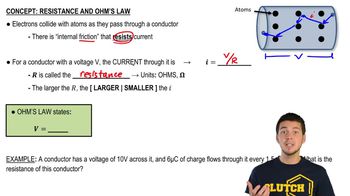
Ohm's Law states that the current (I) flowing through a conductor between two points is directly proportional to the voltage (V) across the two points and inversely proportional to the resistance (R) of the conductor. It is mathematically expressed as V = IR. This law is fundamental in electrical engineering for analyzing circuits and understanding the relationship between voltage, current, and resistance.
추천 영상:
가이드 코스
03:07
Resistance and Ohm's Law

Potential Difference

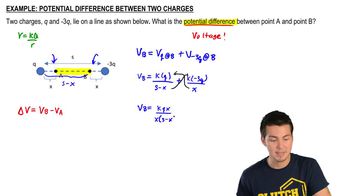
Potential difference, also known as voltage, is the difference in electric potential energy per unit charge between two points in an electric field. It is what drives the flow of electric current in a circuit. In the context of the given question, the potential difference can be calculated using Ohm's Law, where V = IR, allowing us to find the voltage across the wire when the current and resistance are known.
추천 영상:
가이드 코스
07:04
Potential Difference Between Two Charges
관련 실천
교과서 질문

The resistivity of a metal increases slightly with increased temperature. This can be expressed as ρ=ρ₀[1+α(T−T₀)] , where T₀ is a reference temperature, usually 20°C, and α is the temperature coefficient of resistivity. For copper, α=3.9×10⁻³ °C−1. Suppose a 2.5-m-long, 0.40-mm-diameter copper wire is connected across the terminals of a 1.5 V ideal battery. What is the current in the wire at 20°C?

149
views
교과서 질문

You need to design a 1.0 A fuse that 'blows' if the current exceeds 1.0 A. The fuse material in your stockroom melts at a current density of 500 A/cm2. What diameter wire of this material will do the job?

65
views
교과서 질문

A hollow metal cylinder has inner radius a, outer radius b, length L, and conductivity σ. The current I is radially outward from the inner surface to the outer surface. Evaluate the electric field strength at the inner and outer surfaces of an iron cylinder if a=1.0 cm, b=2.5 cm, L=10 cm, and I=25 A.

135
views
교과서 질문

Variations in the resistivity of blood can give valuable clues about changes in various properties of the blood. Suppose a medical device inserts microelectrodes into a 1.5-mm-diameter vein at positions 5.0 cm apart. What is the blood resistivity if a 9.0 V potential difference causes a 230 μA current through the blood in the vein?

324
views
교과서 질문

Electrical engineers sometimes use a wire's conductance, G=σA/L, instead of its resistance. What is the conductance of a 5.4-cm-long, 0.15-mm-diameter tungsten wire?

96
views
교과서 질문

The biochemistry that takes place inside cells depends on various elements, such as sodium, potassium, and calcium, that are dissolved in water as ions. These ions enter cells through narrow pores in the cell membrane known as ion channels. Each ion channel, which is formed from a specialized protein molecule, is selective for one type of ion. Measurements with microelectrodes have shown that a 0.30-nm-diameter potassium ion (K+) channel carries a current of 1.8 pA. How many potassium ions pass through if the ion channel opens for 1.0 ms?

81
views