
Ch 27: Current and Resistance
Knight Calc - Physics for Scientists and Engineers 5th Edition
Knight Calc5th EditionPhysics for Scientists and EngineersISBN: 9780137344796당신이 사용하는 게 아니라요?교과서 변경
27장, 문제 50

Variations in the resistivity of blood can give valuable clues about changes in various properties of the blood. Suppose a medical device inserts microelectrodes into a 1.5-mm-diameter vein at positions 5.0 cm apart. What is the blood resistivity if a 9.0 V potential difference causes a 230 μA current through the blood in the vein?

검증된 단계별 안내
1
Step 1: Recall the formula for resistance in terms of resistivity: \( R = \frac{\rho \cdot L}{A} \), where \( R \) is the resistance, \( \rho \) is the resistivity, \( L \) is the length of the conductor (in this case, the vein), and \( A \) is the cross-sectional area of the conductor.
Step 2: Use Ohm's Law to find the resistance \( R \): \( R = \frac{V}{I} \), where \( V \) is the potential difference (9.0 V) and \( I \) is the current (230 μA or \( 230 \times 10^{-6} \) A). Substitute the given values into this formula to calculate \( R \).
Step 3: Calculate the cross-sectional area \( A \) of the vein. The vein is cylindrical, so \( A = \pi r^2 \), where \( r \) is the radius of the vein. The diameter is given as 1.5 mm, so \( r = \frac{1.5}{2} \) mm = 0.75 mm = \( 0.75 \times 10^{-3} \) m. Substitute this value into the formula for \( A \).
Step 4: Rearrange the resistivity formula \( \rho = \frac{R \cdot A}{L} \) to solve for \( \rho \). Here, \( L \) is the distance between the electrodes, which is given as 5.0 cm = 0.05 m. Substitute the values of \( R \), \( A \), and \( L \) into this formula.
Step 5: Perform the calculations to find the resistivity \( \rho \). Ensure all units are consistent (e.g., meters for length, square meters for area, ohms for resistance) before substituting into the formula.

비슷한 문제에 대한 검증된 영상 답변:

이 영상 해법은 위 문제에 도움이 된다고 튜터들이 추천한 것입니다.
도움이 되었나요?

주요 개념

질문에 올바르게 답하기 위해 반드시 이해해야 하는 핵심 개념들은 다음과 같습니다.

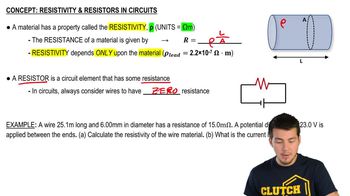
Resistivity

Resistivity is a material property that quantifies how strongly a given material opposes the flow of electric current. It is defined as the resistance of a unit cube of the material and is typically measured in ohm-meters (Ω·m). In biological contexts, such as blood, resistivity can vary due to factors like temperature, composition, and cellular structure, making it a useful parameter for diagnosing health conditions.
추천 영상:
05:25
Resistivity & Resistors in Circuits

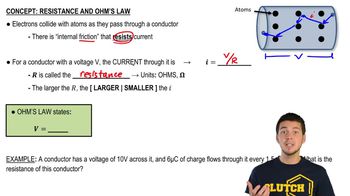
Ohm's Law

Ohm's Law is a fundamental principle in electrical engineering and physics that relates voltage (V), current (I), and resistance (R) in a circuit. It states that V = I × R, meaning the voltage across a conductor is directly proportional to the current flowing through it, with resistance as the proportionality constant. This law is essential for calculating resistivity when the voltage and current are known.
추천 영상:
03:07
Resistance and Ohm's Law

Geometric Factors in Resistance

The resistance of a cylindrical conductor, such as a blood vessel, depends on its length and cross-sectional area. The formula for resistance (R) is R = ρ(L/A), where ρ is resistivity, L is the length of the conductor, and A is its cross-sectional area. In this case, the diameter of the vein and the distance between the electrodes are crucial for determining the effective resistance and, consequently, the resistivity of the blood.
추천 영상:
05:25
Resistivity & Resistors in Circuits
관련 실천
교과서 질문

A sculptor has asked you to help electroplate gold onto a brass statue. You know that the charge carriers in the ionic solution are singly charged gold ions, and you've calculated that you must deposit 0.50 g of gold to reach the necessary thickness. How much current do you need, in mA, to plate the statue in 3.0 hours?

85
views
교과서 질문

Thermistors, resistors whose resistance is a sensitive function of temperature, are widely used in industry and consumer devices to measure temperature. The resistance of a thermistor at temperature T can be modeled as R=R₀exp[β(1/T−1/T₀)], where T₀ is a reference temperature, the temperatures are in K, and β is a constant with units of K. Suppose you connect a thermistor to a 10.0 V battery and measure the current through it at different temperatures. At 25.0°C, which you select as your reference temperature, the current is 10.0 mA. Raising the temperature to 30.0°C causes the current to increase to 12.5 mA. What is the value of β?

40
views
교과서 질문

You need to design a 1.0 A fuse that 'blows' if the current exceeds 1.0 A. The fuse material in your stockroom melts at a current density of 500 A/cm2. What diameter wire of this material will do the job?

65
views
교과서 질문

Electrical engineers sometimes use a wire's conductance, G=σA/L, instead of its resistance. A 1.5 A current flows through the wire of part b. What is the potential difference between the ends of the wire?

74
views
교과서 질문

Electrical engineers sometimes use a wire's conductance, G=σA/L, instead of its resistance. What is the conductance of a 5.4-cm-long, 0.15-mm-diameter tungsten wire?

96
views
교과서 질문

The biochemistry that takes place inside cells depends on various elements, such as sodium, potassium, and calcium, that are dissolved in water as ions. These ions enter cells through narrow pores in the cell membrane known as ion channels. Each ion channel, which is formed from a specialized protein molecule, is selective for one type of ion. Measurements with microelectrodes have shown that a 0.30-nm-diameter potassium ion (K+) channel carries a current of 1.8 pA. How many potassium ions pass through if the ion channel opens for 1.0 ms?

81
views