Ch 28: Fundamentals of Circuits
Knight Calc - Physics for Scientists and Engineers 5th Edition
Knight Calc5th EditionPhysics for Scientists and EngineersISBN: 9780137344796당신이 사용하는 게 아니라요?교과서 변경
28장, 문제 24

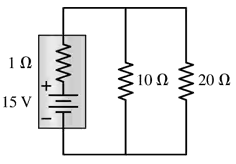
Compared to an ideal battery, by what percentage does the battery's internal resistance reduce the potential difference across the 20 Ω resistor in FIGURE EX28.24?
Circuit diagram showing a 15V battery with 1Ω internal resistance connected to 10Ω and 20Ω resistors in parallel.

검증된 단계별 안내
1
Identify the key components of the circuit: the ideal battery's emf (E), the internal resistance of the battery (r), and the external resistor (R = 20 Ω). The goal is to determine the percentage reduction in the potential difference across the external resistor due to the internal resistance.
Write the expression for the total resistance in the circuit: \( R_{\text{total}} = R + r \), where \( R \) is the external resistance and \( r \) is the internal resistance of the battery.
Use Ohm's Law to calculate the total current in the circuit: \( I = \frac{E}{R_{\text{total}}} = \frac{E}{R + r} \), where \( E \) is the emf of the battery.
Determine the potential difference across the external resistor \( R \): \( V_R = I \cdot R = \frac{E \cdot R}{R + r} \). This is the actual potential difference across the resistor when the internal resistance is considered.
Compare the actual potential difference \( V_R \) to the ideal potential difference \( V_{\text{ideal}} = E \) (when \( r = 0 \)). The percentage reduction is given by: \( \text{Percentage Reduction} = \frac{V_{\text{ideal}} - V_R}{V_{\text{ideal}}} \times 100 = \frac{E - \frac{E \cdot R}{R + r}}{E} \times 100 \). Simplify this expression to find the percentage reduction.

비슷한 문제에 대한 검증된 영상 답변:

이 영상 해법은 위 문제에 도움이 된다고 튜터들이 추천한 것입니다.
영상 길이:
11m
도움이 되었나요?

주요 개념

질문에 올바르게 답하기 위해 반드시 이해해야 하는 핵심 개념들은 다음과 같습니다.

Internal Resistance

Internal resistance refers to the opposition to the flow of electric current within a battery or power source. It causes a voltage drop when current flows, reducing the effective voltage available to external components. Understanding internal resistance is crucial for analyzing real-world battery performance, as it directly impacts the potential difference across connected loads.
추천 영상:
가이드 코스
04:54
Total Internal Energy

Ohm's Law

Ohm's Law states that the current (I) flowing through a conductor between two points is directly proportional to the voltage (V) across the two points and inversely proportional to the resistance (R) of the conductor. This relationship is expressed as V = IR. In the context of the question, Ohm's Law helps determine how the internal resistance affects the voltage across the 20 Ω resistor.
추천 영상:
가이드 코스
03:07
Resistance and Ohm's Law

Voltage Divider Rule

The Voltage Divider Rule is a principle used in electrical circuits to determine the voltage drop across components in series. It states that the voltage across a resistor in a series circuit is a fraction of the total voltage, proportional to the resistance of that resistor. This concept is essential for calculating how much the internal resistance of the battery affects the voltage across the 20 Ω resistor.
추천 영상:
가이드 코스
04:08
Kirchhoff's Junction Rule