
Ch 28: Fundamentals of Circuits
Knight Calc - Physics for Scientists and Engineers 5th Edition
Knight Calc5th EditionPhysics for Scientists and EngineersISBN: 9780137344796당신이 사용하는 게 아니라요?교과서 변경
28장, 문제 67

The capacitor in an RC circuit is discharged with a time constant of 10 ms. At what time after the discharge begins are (a) the charge on the capacitor reduced to half its initial value and (b) the energy stored in the capacitor reduced to half its initial value?

검증된 단계별 안내
1
Step 1: Understand the concept of the time constant (τ) in an RC circuit. The time constant is defined as τ = RC, where R is the resistance and C is the capacitance. It represents the time it takes for the charge or current to decay to approximately 37% of its initial value.
Step 2: Use the formula for the charge on a capacitor during discharge: Q(t) = Q₀ * e^(-t/τ), where Q₀ is the initial charge, t is the time, and τ is the time constant. To find the time when the charge is reduced to half its initial value, set Q(t) = Q₀/2 and solve for t.
Step 3: Rearrange the equation Q₀/2 = Q₀ * e^(-t/τ) to isolate t. Divide both sides by Q₀, resulting in 1/2 = e^(-t/τ). Take the natural logarithm (ln) of both sides to solve for t: ln(1/2) = -t/τ.
Step 4: Solve for t using the relationship t = -τ * ln(1/2). Substitute τ = 10 ms into the equation to find the time when the charge is reduced to half its initial value. Note that ln(1/2) is equivalent to -ln(2).
Step 5: For part (b), recall that the energy stored in a capacitor is proportional to the square of the charge: U(t) = (1/2) * C * [Q(t)]². To find the time when the energy is reduced to half its initial value, set U(t) = U₀/2 and solve for t using the same exponential decay formula for Q(t). This will involve solving for t in the equation Q(t) = Q₀/√2.

비슷한 문제에 대한 검증된 영상 답변:

이 영상 해법은 위 문제에 도움이 된다고 튜터들이 추천한 것입니다.
영상 길이:
10m

주요 개념

질문에 올바르게 답하기 위해 반드시 이해해야 하는 핵심 개념들은 다음과 같습니다.

Time Constant

The time constant (τ) in an RC circuit is a measure of the time it takes for the charge or voltage to decay to approximately 37% of its initial value. It is calculated as τ = R × C, where R is the resistance and C is the capacitance. In this case, a time constant of 10 ms indicates that after this duration, the charge on the capacitor will have decreased significantly, providing a basis for understanding the discharge process.
추천 영상:
가이드 코스
08:59
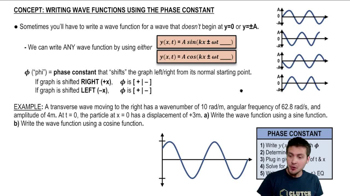
Phase Constant of a Wave Function

Exponential Decay

The discharge of a capacitor follows an exponential decay model, described by the equation Q(t) = Q0 e^(-t/τ), where Q(t) is the charge at time t, Q0 is the initial charge, and e is the base of the natural logarithm. This means that the charge decreases rapidly at first and then more slowly over time, which is crucial for determining when the charge reaches half its initial value.
추천 영상:
가이드 코스
04:24
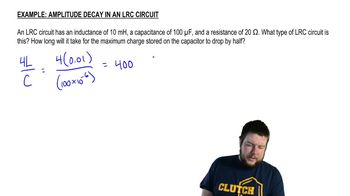
Amplitude Decay in an LRC Circuit

Energy Stored in a Capacitor

The energy (U) stored in a capacitor is given by the formula U = 1/2 C V^2, where C is the capacitance and V is the voltage across the capacitor. As the capacitor discharges, both the charge and voltage decrease, leading to a reduction in stored energy. Understanding how energy relates to charge and voltage is essential for calculating when the energy is halved during the discharge process.
추천 영상:
가이드 코스
09:26
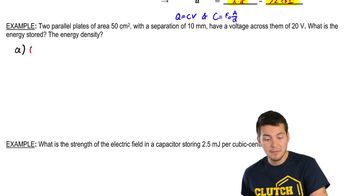
Energy Stored by Capacitor