
Ch 28: Fundamentals of Circuits
Knight Calc - Physics for Scientists and Engineers 5th Edition
Knight Calc5th EditionPhysics for Scientists and EngineersISBN: 9780137344796당신이 사용하는 게 아니라요?교과서 변경
28장, 문제 69

A 150 μF defibrillator capacitor is charged to 1500 V. When fired through a patient’s chest, it loses 95% of its charge in 40 ms. What is the resistance of the patient’s chest?

검증된 단계별 안내
1
Step 1: Recognize that the capacitor discharges through the patient's chest, which can be modeled as an RC circuit. The voltage across the capacitor during discharge follows the equation: Vt=V0e-tτ, where τ is the time constant of the circuit.
Step 2: The time constant τ is given by the formula: τ=RC, where R is the resistance and C is the capacitance.
Step 3: Use the information that the capacitor loses 95% of its charge in 40 ms. This means the voltage drops to 5% of its initial value. Substitute this into the discharge equation: Vt=V0e-tτ, where Vt=0.05V0 and t=40ms.
Step 4: Solve for the time constant τ using the equation: e-tτ=0.05. Take the natural logarithm of both sides to isolate tτ: -tτ=ln(0.05). Rearrange to find τ: τ=t-ln(0.05).
Step 5: Once τ is calculated, use the formula τ=RC to solve for the resistance R. Substitute the given capacitance C=150μF and the calculated value of τ into the equation to find R.

비슷한 문제에 대한 검증된 영상 답변:

이 영상 해법은 위 문제에 도움이 된다고 튜터들이 추천한 것입니다.
도움이 되었나요?

주요 개념

질문에 올바르게 답하기 위해 반드시 이해해야 하는 핵심 개념들은 다음과 같습니다.

Capacitance

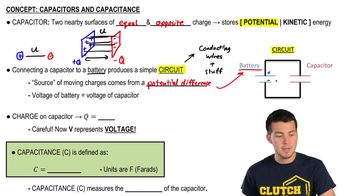
Capacitance is the ability of a capacitor to store electrical charge per unit voltage. It is measured in farads (F), and in this case, the defibrillator capacitor has a capacitance of 150 μF (microfarads). The charge (Q) stored in a capacitor can be calculated using the formula Q = C × V, where C is capacitance and V is voltage.
추천 영상:
가이드 코스
08:02
Capacitors & Capacitance (Intro)

Exponential Decay of Charge

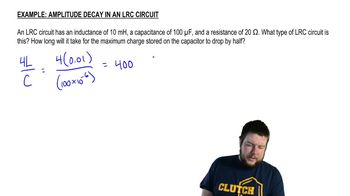
When a capacitor discharges through a resistor, the charge decreases exponentially over time. The relationship is described by the equation Q(t) = Q0 * e^(-t/RC), where Q0 is the initial charge, R is resistance, and C is capacitance. In this scenario, the capacitor loses 95% of its charge in 40 ms, which can be used to find the resistance of the patient's chest.
추천 영상:
가이드 코스
04:24
Amplitude Decay in an LRC Circuit

Ohm's Law

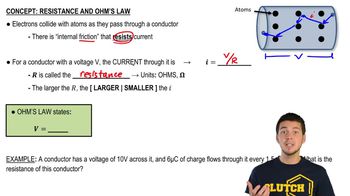
Ohm's Law relates voltage (V), current (I), and resistance (R) in an electrical circuit, expressed as V = I × R. In the context of the defibrillator, understanding this relationship is crucial for calculating the resistance of the patient's chest based on the current flowing through it as the capacitor discharges. This law helps in determining how the resistance affects the rate of charge loss.
추천 영상:
가이드 코스
03:07
Resistance and Ohm's Law