
You’ve made the finals of the Science Olympics! As one of your tasks, you’re given 1.0 g of aluminum and asked to make a wire, using all the aluminum, that will dissipate 7.5 W when connected to a 1.5 V battery. What length and diameter will you choose for your wire?
Ch 28: Fundamentals of Circuits
28장, 문제 75b
The flash on a compact camera stores energy in a 120 μF capacitor that is charged to 220 V. When the flash is fired, the capacitor is quickly discharged through a lightbulb with 5.0 Ω of resistance. At what rate is the lightbulb dissipating energy 250 μs after the flash is fired?
검증된 단계별 안내1
Step 1: Understand the problem. The capacitor discharges through the lightbulb, and we need to calculate the rate at which the lightbulb dissipates energy (power) 250 μs after the flash is fired. This involves using the formula for power dissipation in a resistor: \( P = \frac{V^2}{R} \), where \( V \) is the voltage across the resistor and \( R \) is the resistance.
Step 2: Recall the formula for the voltage across a discharging capacitor as a function of time: \( V(t) = V_0 e^{-t / \tau} \), where \( V_0 \) is the initial voltage, \( t \) is the time elapsed, and \( \tau \) is the time constant of the circuit. The time constant is given by \( \tau = RC \), where \( R \) is the resistance and \( C \) is the capacitance.
Step 3: Calculate the time constant \( \tau \) using \( \tau = RC \). Substitute \( R = 5.0 \ \Omega \) and \( C = 120 \ \mu F = 120 \times 10^{-6} \ \text{F} \). This will give the value of \( \tau \).
Step 4: Determine the voltage \( V(t) \) at \( t = 250 \ \mu s = 250 \times 10^{-6} \ \text{s} \) using the formula \( V(t) = V_0 e^{-t / \tau} \). Substitute \( V_0 = 220 \ \text{V} \), \( t = 250 \times 10^{-6} \ \text{s} \), and the calculated \( \tau \) from Step 3.
Step 5: Calculate the power dissipated by the lightbulb at \( t = 250 \ \mu s \) using \( P = \frac{V^2}{R} \). Substitute the value of \( V(t) \) from Step 4 and \( R = 5.0 \ \Omega \) into the formula to find the rate of energy dissipation.

비슷한 문제에 대한 검증된 영상 답변:
이 영상 해법은 위 문제에 도움이 된다고 튜터들이 추천한 것입니다.
영상 길이:
2m도움이 되었나요?
주요 개념
질문에 올바르게 답하기 위해 반드시 이해해야 하는 핵심 개념들은 다음과 같습니다.
Capacitance
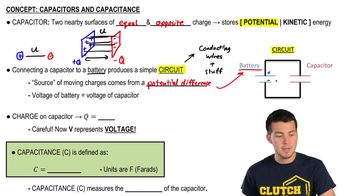
Capacitance is the ability of a capacitor to store electrical energy in an electric field, measured in farads (F). In this scenario, the 120 μF capacitor stores energy when charged to 220 V. The energy (E) stored in a capacitor can be calculated using the formula E = 1/2 C V², where C is capacitance and V is voltage.
추천 영상:
가이드 코스
Capacitors & Capacitance (Intro)
Ohm's Law
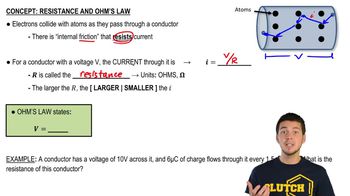
Ohm's Law relates voltage (V), current (I), and resistance (R) in an electrical circuit, expressed as V = I R. This fundamental principle allows us to determine the current flowing through the lightbulb when the capacitor discharges. Understanding this relationship is crucial for calculating the power dissipated by the lightbulb at any given time.
추천 영상:
가이드 코스
Resistance and Ohm's Law
Power Dissipation
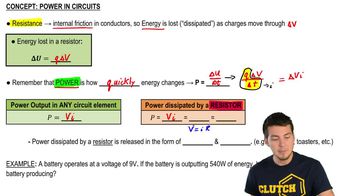
Power dissipation in an electrical component, such as a lightbulb, is the rate at which it converts electrical energy into heat and light, measured in watts (W). It can be calculated using the formula P = I² R, where I is the current through the component and R is its resistance. This concept is essential for determining how much energy the lightbulb dissipates at a specific time after the flash is fired.
추천 영상:
가이드 코스
Power in Circuits
관련 실천
교과서 질문
45
views
교과서 질문
A 15 μF capacitor charged to 12 V is discharged through a resistor. The energy stored in the capacitor decreases by 50% in 0.25 s. What is the value of the resistance?
53
views
교과서 질문
The capacitor in FIGURE P28.73 begins to charge after the switch closes at t = 0 s. Find an expression for the current I at time t. Graph I from t = 0 to t = 5τ.
643
views
교과서 질문
A 150 μF defibrillator capacitor is charged to 1500 V. When fired through a patient’s chest, it loses 95% of its charge in 40 ms. What is the resistance of the patient’s chest?
62
views
