Ch 29: The Magnetic Field
Knight Calc - Physics for Scientists and Engineers 5th Edition
Knight Calc5th EditionPhysics for Scientists and EngineersISBN: 9780137344796당신이 사용하는 게 아니라요?교과서 변경
29장, 문제 3

A proton moves along the x-axis with vₓ = 1.0 x 10⁷ m/s. As it passes the origin, what are the strength and direction of the magnetic field at the (x, y, z) positions (a) (1 cm, 0 cm, 0 cm), (b) (0 cm, 1 cm, 0 cm), and (c) (0 cm, -2 cm, 0 cm)?

검증된 단계별 안내
1
Step 1: Recall the formula for the magnetic field produced by a moving charge. The magnetic field at a point due to a moving charge is given by **B = (μ₀ / 4π) * (q * v × r̂) / r²**, where μ₀ is the permeability of free space, q is the charge, v is the velocity vector, r̂ is the unit vector pointing from the charge to the observation point, and r is the distance between the charge and the observation point.
Step 2: Identify the given values. The charge of a proton is q = 1.6 × 10⁻¹⁹ C, the velocity vector is **v = (1.0 × 10⁷ m/s) î**, and the observation points are (a) (1 cm, 0 cm, 0 cm), (b) (0 cm, 1 cm, 0 cm), and (c) (0 cm, -2 cm, 0 cm). Convert the distances to meters: 1 cm = 0.01 m, 2 cm = 0.02 m.
Step 3: For each observation point, calculate the distance vector **r** and the unit vector **r̂**. For example, for point (a), **r = (0.01 m) î**, and **r̂ = r / |r| = î**. Similarly, calculate **r** and **r̂** for points (b) and (c).
Step 4: Compute the cross product **v × r̂** for each observation point. For point (a), since **v** and **r̂** are parallel, the cross product is zero, meaning the magnetic field at (1 cm, 0 cm, 0 cm) is zero. For points (b) and (c), use the right-hand rule to determine the direction of **v × r̂** and calculate its magnitude.
Step 5: Substitute the values into the formula for **B** to find the magnitude and direction of the magnetic field at each point. Use the calculated **v × r̂**, the distance **r**, and the constants μ₀ = 4π × 10⁻⁷ T·m/A and q = 1.6 × 10⁻¹⁹ C to determine the magnetic field strength at points (b) and (c).

비슷한 문제에 대한 검증된 영상 답변:

이 영상 해법은 위 문제에 도움이 된다고 튜터들이 추천한 것입니다.
영상 길이:
6m
도움이 되었나요?

주요 개념

질문에 올바르게 답하기 위해 반드시 이해해야 하는 핵심 개념들은 다음과 같습니다.

Magnetic Field Due to a Moving Charge

A moving charge, such as a proton, generates a magnetic field around it. The strength and direction of this magnetic field can be determined using the right-hand rule and the Biot-Savart law, which relates the magnetic field to the velocity of the charge and its distance from the point of interest.
추천 영상:
가이드 코스
10:47
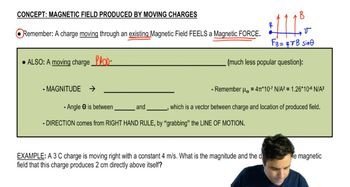
Magnetic Field Produced by Moving Charges

Right-Hand Rule

The right-hand rule is a mnemonic used to determine the direction of the magnetic field produced by a moving charge. By pointing the thumb of the right hand in the direction of the charge's velocity and curling the fingers, the direction of the magnetic field lines can be found, which are perpendicular to both the velocity and the direction of the magnetic field.
추천 영상:
가이드 코스
19:11
Force on Moving Charges & Right Hand Rule

Coordinate System and Position Vectors

In physics, a coordinate system is used to define the position of points in space. The positions given in the question (e.g., (1 cm, 0 cm, 0 cm)) represent points in a three-dimensional Cartesian coordinate system, where the x, y, and z coordinates indicate the location in space relative to the origin. Understanding this system is crucial for calculating the magnetic field at specific points.
추천 영상:
가이드 코스
07:07
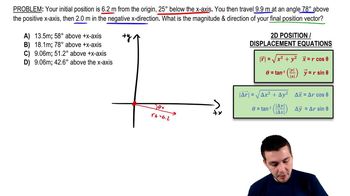
Final Position Vector