Ch 29: The Magnetic Field
Knight Calc - Physics for Scientists and Engineers 5th Edition
Knight Calc5th EditionPhysics for Scientists and EngineersISBN: 9780137344796당신이 사용하는 게 아니라요?교과서 변경
29장, 문제 8

The element niobium, which is a metal, is a superconductor (i.e., no electrical resistance) at temperatures below 9 K. However, the superconductivity is destroyed if the magnetic field at the surface of the metal reaches or exceeds 0.10 T. What is the maximum current in a straight, 3.0-mm-diameter superconducting niobium wire?

검증된 단계별 안내
1
Step 1: Begin by understanding the relationship between the magnetic field produced by a current in a wire and the current itself. The magnetic field at the surface of a straight wire carrying current is given by the formula: B = μ0I2πr, where B is the magnetic field, μ0 is the permeability of free space (4π × 10-7 T·m/A), I is the current, and r is the radius of the wire.
Step 2: Identify the given values in the problem. The maximum magnetic field B is 0.10 T, and the diameter of the wire is 3.0 mm. Convert the diameter to radius by dividing by 2, and express it in meters: r = 3.02 × 10⁻³ m.
Step 3: Rearrange the formula to solve for the current I. The rearranged formula is: I = B2πrμ0. Substitute the known values for B, r, and μ0 into the equation.
Step 4: Perform the substitution step. Use B = 0.10, r = 1.5 × 10⁻³, and μ0 = 4π × 10-7. The equation becomes: I = 0.102π × 1.5 × 10-34π × 10-7.
Step 5: Simplify the expression to calculate the maximum current I. Ensure proper unit consistency throughout the calculation. The result will give the maximum current that the superconducting niobium wire can carry without losing its superconductivity.

비슷한 문제에 대한 검증된 영상 답변:

이 영상 해법은 위 문제에 도움이 된다고 튜터들이 추천한 것입니다.
도움이 되었나요?

주요 개념

질문에 올바르게 답하기 위해 반드시 이해해야 하는 핵심 개념들은 다음과 같습니다.

Superconductivity

Superconductivity is a phenomenon where certain materials exhibit zero electrical resistance and the expulsion of magnetic fields when cooled below a critical temperature. In this state, electrical current can flow without energy loss, making superconductors highly efficient for various applications. The critical temperature and the critical magnetic field are key parameters that define the superconducting state.

Critical Magnetic Field

The critical magnetic field is the maximum magnetic field strength that a superconductor can withstand while maintaining its superconducting properties. If the magnetic field exceeds this threshold, superconductivity is destroyed, and the material reverts to a normal conductive state. For niobium, this critical field is 0.10 T, which is crucial for determining the maximum current it can carry without losing its superconducting ability.
추천 영상:
가이드 코스
05:30
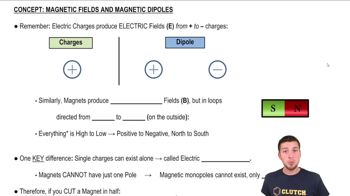
Magnetic Fields and Magnetic Dipoles

Current Density

Current density is defined as the amount of electric current flowing per unit area of a cross-section of a conductor. It is typically expressed in amperes per square meter (A/m²). In superconductors, the maximum current that can be carried is influenced by the critical magnetic field and the physical dimensions of the wire, allowing for calculations of the maximum current based on the wire's diameter and the properties of the superconducting material.
추천 영상:
가이드 코스
8:13
Intro to Density