

Ch 30: Electromagnetic Induction
Knight Calc - Physics for Scientists and Engineers 5th Edition
Knight Calc5th EditionPhysics for Scientists and EngineersISBN: 9780137344796당신이 사용하는 게 아니라요?교과서 변경
30장, 문제 55c

INT A 20-cm-long, zero-resistance slide wire moves outward, on zero-resistance rails, at a steady speed of 10 m/s in a 0.10 T magnetic field. (See Figure 30.26.) On the opposite side, a 1.0 Ω carbon resistor completes the circuit by connecting the two rails. The mass of the resistor is 50 mg. If the wire is pulled for 10 s, what is the temperature increase of the carbon? The specific heat of carbon is 710 J/kg K.

검증된 단계별 안내
1
Step 1: Calculate the electromotive force (EMF) induced in the slide wire using Faraday's law of induction. The formula for EMF is \( \text{EMF} = B \cdot v \cdot L \), where \( B \) is the magnetic field strength (0.10 T), \( v \) is the velocity of the wire (10 m/s), and \( L \) is the length of the wire (0.20 m).
Step 2: Determine the current \( I \) flowing through the circuit using Ohm's law. The formula is \( I = \frac{\text{EMF}}{R} \), where \( R \) is the resistance of the carbon resistor (1.0 Ω).
Step 3: Calculate the power dissipated in the resistor using the formula \( P = I^2 \cdot R \). This represents the rate at which electrical energy is converted into heat in the resistor.
Step 4: Find the total energy dissipated over the 10-second interval. Use the formula \( E = P \cdot t \), where \( t \) is the time duration (10 s). This gives the total heat energy transferred to the resistor.
Step 5: Calculate the temperature increase of the carbon resistor using the formula \( \Delta T = \frac{E}{m \cdot c} \), where \( m \) is the mass of the resistor (50 mg or 0.00005 kg) and \( c \) is the specific heat capacity of carbon (710 J/kg K).

비슷한 문제에 대한 검증된 영상 답변:

이 영상 해법은 위 문제에 도움이 된다고 튜터들이 추천한 것입니다.
도움이 되었나요?

주요 개념

질문에 올바르게 답하기 위해 반드시 이해해야 하는 핵심 개념들은 다음과 같습니다.

Electromagnetic Induction

Electromagnetic induction is the process by which a changing magnetic field within a closed loop induces an electromotive force (EMF) in the wire. In this scenario, as the slide wire moves through the magnetic field, it experiences a change in magnetic flux, leading to the generation of an induced current that flows through the circuit, including the resistor.
추천 영상:
가이드 코스
05:42
Introduction to Induction

Joule Heating

Joule heating, also known as resistive heating, occurs when an electric current passes through a resistor, converting electrical energy into thermal energy. The amount of heat generated can be calculated using the formula Q = I²Rt, where Q is the heat produced, I is the current, R is the resistance, and t is the time. This principle is crucial for determining the temperature increase of the carbon resistor.
추천 영상:
가이드 코스
05:14
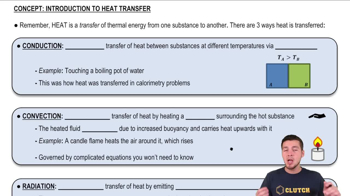
Overview of Heat Transfer

Specific Heat Capacity

Specific heat capacity is the amount of heat required to raise the temperature of a unit mass of a substance by one degree Celsius (or one Kelvin). It is a material-specific property, and for carbon, it is given as 710 J/kg K. This concept is essential for calculating the temperature change of the carbon resistor after it absorbs the heat generated from the current flowing through it.
추천 영상:
가이드 코스
06:50
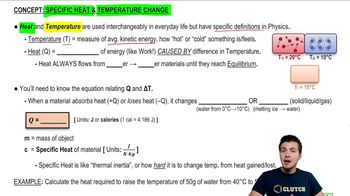
Specific Heat & Temperature Changes
관련 실천
교과서 질문

CALC Your camping buddy has an idea for a light to go inside your tent. He happens to have a powerful (and heavy!) horseshoe magnet that he bought at a surplus store. This magnet creates a 0.20 T field between two pole tips 10 cm apart. His idea is to build the hand-cranked generator shown in FIGURE P30.57. He thinks you can make enough current to fully light a 1.0 Ω lightbulb rated at 4.0 W. That's not super bright, but it should be plenty of light for routine activities in the tent. Find an expression for the induced current as a function of time if you turn the crank at frequency f. Assume that the semicircle is at its highest point at t = 0 s.

70
views
교과서 질문

INT A 20-cm-long, zero-resistance slide wire moves outward, on zero-resistance rails, at a steady speed of 10 m/s in a 0.10 T magnetic field. (See Figure 30.26.) On the opposite side, a 1.0 Ω carbon resistor completes the circuit by connecting the two rails. The mass of the resistor is 50 mg. How much force is needed to pull the wire at this speed?

236
views
교과서 질문

CALC The L-shaped conductor in FIGURE P30.54 moves at 10 m/s across and touches a stationary L-shaped conductor in a 0.10 T magnetic field. The two vertices overlap, so that the enclosed area is zero, at t = 0 s. The conductor has a resistance of 0.010 ohms per meter. a. What is the direction of the induced current?

1402
views
교과서 질문

INT A 20-cm-long, zero-resistance slide wire moves outward, on zero-resistance rails, at a steady speed of 10 m/s in a 0.10 T magnetic field. (See Figure 30.26.) On the opposite side, a 1.0 Ω carbon resistor completes the circuit by connecting the two rails. The mass of the resistor is 50 mg. What is the induced current in the circuit?

97
views
교과서 질문

INT You've decided to make the magnetic projectile launcher shown in FIGURE P30.58 for your science project. An aluminum bar slides along metal rails through a magnetic field B. The switch closes at t = 0 s, while the bar is at rest, and a battery of emf εbat starts a current flowing around the loop. The battery has internal resistance r. The resistances of the rails, which are separated by distance l, and the bar are effectively zero. Show that the bar reaches a terminal speed vterm, and find an expression for vterm.

48
views
교과서 질문

CALC Your camping buddy has an idea for a light to go inside your tent. He happens to have a powerful (and heavy!) horseshoe magnet that he bought at a surplus store. This magnet creates a 0.20 T field between two pole tips 10 cm apart. His idea is to build the hand-cranked generator shown in FIGURE P30.57. He thinks you can make enough current to fully light a 1.0 Ω lightbulb rated at 4.0 W. That's not super bright, but it should be plenty of light for routine activities in the tent. With what frequency will you have to turn the crank for the maximum current to fully light the bulb? Is this feasible?

59
views