
Ch 31: Electromagnetic Fields and Waves
Knight Calc - Physics for Scientists and Engineers 5th Edition
Knight Calc5th EditionPhysics for Scientists and EngineersISBN: 9780137344796당신이 사용하는 게 아니라요?교과서 변경
31장, 문제 66b

Consider current I passing through a resistor of radius r, length L, and resistance R. Determine the strength and direction of the Poynting vector at the surface of the resistor.

검증된 단계별 안내
1
Step 1: Recall the formula for the Poynting vector, which represents the energy flux density of an electromagnetic field. The Poynting vector **S** is given by \( \mathbf{S} = \frac{1}{\mu_0} \mathbf{E} \times \mathbf{B} \), where \( \mathbf{E} \) is the electric field, \( \mathbf{B} \) is the magnetic field, and \( \mu_0 \) is the permeability of free space.
Step 2: Determine the electric field \( \mathbf{E} \) at the surface of the resistor. The electric field inside the resistor is related to the current \( I \) and the resistance \( R \) by Ohm's law: \( \mathbf{E} = \frac{I}{\sigma A} \), where \( \sigma \) is the conductivity of the material and \( A \) is the cross-sectional area of the resistor. At the surface, the electric field is tangential to the resistor's surface.
Step 3: Calculate the magnetic field \( \mathbf{B} \) at the surface of the resistor. Using Ampere's law, the magnetic field around a cylindrical resistor carrying current \( I \) is given by \( B = \frac{\mu_0 I}{2 \pi r} \), where \( r \) is the radius of the resistor. The direction of \( \mathbf{B} \) is azimuthal, encircling the resistor.
Step 4: Compute the cross product \( \mathbf{E} \times \mathbf{B} \) to find the Poynting vector \( \mathbf{S} \). The direction of \( \mathbf{S} \) is radially inward toward the resistor's surface, indicating that electromagnetic energy is flowing into the resistor. The magnitude of \( \mathbf{S} \) can be calculated using the magnitudes of \( \mathbf{E} \) and \( \mathbf{B} \) and the sine of the angle between them (which is 90 degrees, as they are perpendicular).
Step 5: Interpret the physical meaning of the Poynting vector. The inward direction of \( \mathbf{S} \) at the surface of the resistor signifies that electromagnetic energy is being delivered to the resistor, where it is dissipated as heat due to the resistance \( R \). This aligns with the principle of energy conservation in the resistor.

비슷한 문제에 대한 검증된 영상 답변:

이 영상 해법은 위 문제에 도움이 된다고 튜터들이 추천한 것입니다.
도움이 되었나요?

주요 개념

질문에 올바르게 답하기 위해 반드시 이해해야 하는 핵심 개념들은 다음과 같습니다.

Poynting Vector

The Poynting vector represents the directional energy flux (the rate of energy transfer per unit area) of an electromagnetic field. It is defined as the cross product of the electric field vector (E) and the magnetic field vector (B), given by S = E x B. The direction of the Poynting vector indicates the direction in which electromagnetic energy is flowing, which is crucial for understanding energy transfer in circuits.
추천 영상:
가이드 코스
06:44
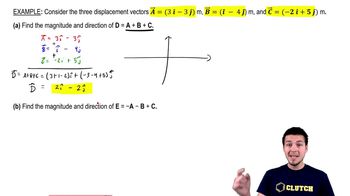
Adding 3 Vectors in Unit Vector Notation

Ohm's Law

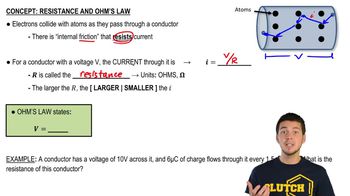
Ohm's Law states that the current (I) flowing through a conductor between two points is directly proportional to the voltage (V) across the two points and inversely proportional to the resistance (R) of the conductor. Mathematically, it is expressed as V = IR. This law is fundamental in analyzing electrical circuits, as it helps determine how voltage, current, and resistance interact within a resistor.
추천 영상:
가이드 코스
03:07
Resistance and Ohm's Law

Electromagnetic Fields in Conductors

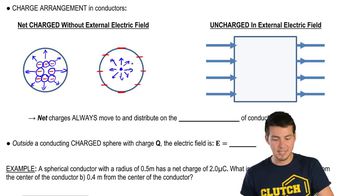
When current flows through a conductor, it generates an electric field and a magnetic field around it. The electric field is responsible for driving the current, while the magnetic field is produced by the movement of charges. Understanding how these fields interact at the surface of a resistor is essential for calculating the Poynting vector, as it reveals how energy is dissipated as heat due to resistance.
추천 영상:
가이드 코스
07:43
Electric Fields in Conductors