Ch 31: Electromagnetic Fields and Waves
Knight Calc - Physics for Scientists and Engineers 5th Edition
Knight Calc5th EditionPhysics for Scientists and EngineersISBN: 9780137344796당신이 사용하는 게 아니라요?교과서 변경
31장, 문제 58

Unpolarized light of intensity I₀ is incident on a stack of 7 polarizing filters, each with its axis rotated 15° cw with respect to the previous filter. What light intensity emerges from the last filter?

검증된 단계별 안내
1
Start by recalling Malus's Law, which states that the intensity of light passing through a polarizing filter is given by: I = I_0 \(\cos\)^2(\(\theta\)), where \(\theta\) is the angle between the light's polarization direction and the filter's axis.
Since the light is unpolarized initially, the intensity after the first polarizer is halved. Thus, the intensity after the first filter is: I_1 = \(\frac{I_0}{2}\).
For each subsequent filter, the light's intensity is reduced according to Malus's Law. The angle between the polarization direction of the light and the axis of each filter increases by 15° for each filter. For the second filter, the intensity is: I_2 = I_1 \(\cos\)^2(15^\(\circ\)). Similarly, for the third filter: I_3 = I_2 \(\cos\)^2(15^\(\circ\)), and so on.
Generalize the process for the stack of 7 filters. The intensity after the nth filter can be expressed as: I_n = I_{n-1} \(\cos\)^2(15^\(\circ\)). By substituting iteratively, the final intensity after the 7th filter is: I_7 = \(\frac{I_0}{2}\) \(\cdot\) \(\cos\)^2(15^\(\circ\)) \(\cdot\) \(\cos\)^2(15^\(\circ\)) \(\cdot\) \(\cos\)^2(15^\(\circ\)) \(\cdot\) \(\cos\)^2(15^\(\circ\)) \(\cdot\) \(\cos\)^2(15^\(\circ\)) \(\cdot\) \(\cos\)^2(15^\(\circ\)).
Simplify the expression for the final intensity: I_7 = \(\frac{I_0}{2}\) \(\cdot\) (\(\cos\)^2(15^\(\circ\)))^6. This is the intensity of light that emerges from the last filter.

비슷한 문제에 대한 검증된 영상 답변:

이 영상 해법은 위 문제에 도움이 된다고 튜터들이 추천한 것입니다.
도움이 되었나요?

주요 개념

질문에 올바르게 답하기 위해 반드시 이해해야 하는 핵심 개념들은 다음과 같습니다.

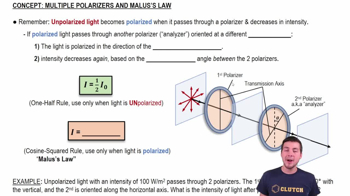
Malus's Law

Malus's Law states that when polarized light passes through a polarizing filter, the intensity of the transmitted light (I) is given by I = I₀ * cos²(θ), where I₀ is the intensity of the incident light and θ is the angle between the light's polarization direction and the filter's axis. This principle is fundamental in understanding how light intensity changes as it passes through multiple polarizers.
추천 영상:
가이드 코스
09:47
Multiple Polarizers & Malus's Law

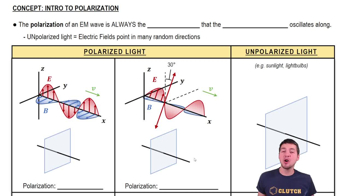
Polarization of Light

Polarization refers to the orientation of the oscillations of light waves. Unpolarized light consists of waves vibrating in multiple planes, while polarized light has waves that oscillate in a single plane. When unpolarized light passes through a polarizer, it becomes polarized, and its intensity is reduced according to the angle of the polarizer relative to the light's initial polarization direction.
추천 영상:
가이드 코스
05:32
Introduction to Polarization

Cumulative Effect of Multiple Polarizers

When unpolarized light passes through multiple polarizing filters, each filter reduces the intensity of the light based on its angle relative to the previous filter. The cumulative effect can be calculated by applying Malus's Law sequentially for each filter. In this case, with 7 filters each rotated by 15°, the intensity after each filter must be calculated iteratively to find the final intensity after the last filter.
추천 영상:
가이드 코스
09:47
Multiple Polarizers & Malus's Law