Ch 34: Ray Optics
Knight Calc - Physics for Scientists and Engineers 5th Edition
Knight Calc5th EditionPhysics for Scientists and EngineersISBN: 9780137344796당신이 사용하는 게 아니라요?교과서 변경
34장, 문제 50

A horizontal meter stick is centered at the bottom of a 3.0-m-deep, 3.0-m-wide pool of water. Suppose you place your eye just above the edge of the pool and look along the direction of the meter stick. What angle do you observe between the two ends of the meter stick if the pool is (a) empty and (b) completely filled with water?

검증된 단계별 안내
1
Determine the geometry of the problem: The meter stick is horizontal and centered at the bottom of the pool. The pool is 3.0 m wide and 3.0 m deep. Your eye is positioned just above the edge of the pool, looking along the direction of the meter stick. The angle observed between the two ends of the meter stick depends on whether the pool is empty or filled with water.
For part (a), when the pool is empty: The light rays from the two ends of the meter stick travel in straight lines to your eye. Use simple trigonometry to calculate the angle. The horizontal distance from the center of the meter stick to the edge of the pool is 1.5 m (half the width of the pool). The vertical distance from the bottom of the pool to your eye is 3.0 m. The angle θ can be calculated using the formula: θ = 2 × tan¹(1.53.0).
For part (b), when the pool is filled with water: Refraction occurs at the water-air interface. Use Snell's law to account for the bending of light. The refractive index of water is approximately 1.33. The light rays from the ends of the meter stick bend as they exit the water. First, calculate the apparent depth of the meter stick using the formula: dapparent = dn, where d is the actual depth (3.0 m) and n is the refractive index of water.
Next, calculate the angle θ for the filled pool. The apparent depth reduces the vertical distance to the meter stick. Use the same trigonometric formula as in part (a), but replace the actual depth with the apparent depth: θ = 2 × tan¹(1.5dapparent).
Summarize the results: The angle observed in part (a) is larger because there is no refraction. In part (b), the angle is smaller due to the bending of light caused by refraction at the water-air interface. This demonstrates how the refractive index of a medium affects the apparent position of objects underwater.

비슷한 문제에 대한 검증된 영상 답변:

이 영상 해법은 위 문제에 도움이 된다고 튜터들이 추천한 것입니다.
도움이 되었나요?

주요 개념

질문에 올바르게 답하기 위해 반드시 이해해야 하는 핵심 개념들은 다음과 같습니다.

Refraction of Light

Refraction is the bending of light as it passes from one medium to another, caused by a change in its speed. In this scenario, light travels from air into water, which has a different refractive index. This bending alters the perceived position of objects submerged in water, affecting the angle observed between the ends of the meter stick.
추천 영상:
03:46
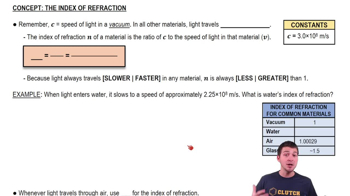
Index of Refraction

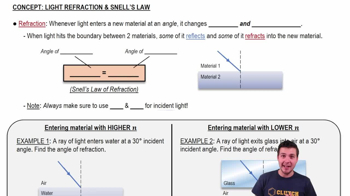
Snell's Law

Snell's Law describes the relationship between the angles of incidence and refraction when light passes through different media. It is mathematically expressed as n1 * sin(θ1) = n2 * sin(θ2), where n is the refractive index and θ is the angle. This law is crucial for calculating the angle observed in the water-filled pool compared to when it is empty.
추천 영상:
07:59
Snell's Law

Visual Angle

The visual angle is the angle formed at the observer's eye by lines extending to the two ends of an object. It is influenced by the distance to the object and the object's size. In this problem, the visual angle changes based on whether the meter stick is in air or submerged in water, due to the effects of refraction.
추천 영상:
01:04
Critical Angle
관련 실천
교과서 질문

A 4.0-m-wide swimming pool is filled to the top. The bottom of the pool becomes completely shaded in the afternoon when the sun is 20° above the horizon. How deep is the pool?

1622
views

교과서 질문

Shown from above in FIGURE P34.54 is one corner of a rectangular box filled with water. A laser beam starts 10 cm from side A of the container and enters the water at position x. You can ignore the thin walls of the container. If x = 15 cm, does the laser beam refract back into the air through side B or reflect from side B back into the water? Determine the angle of refraction or reflection.

1669
views
교과서 질문

The place you get your hair cut has two nearly parallel mirrors 5.0 m apart. As you sit in the chair, your head is 2.0 m from the nearer mirror. Looking toward this mirror, you first see your face and then, farther away, the back of your head. (The mirrors need to be slightly nonparallel for you to be able to see the back of your head, but you can treat them as parallel in this problem.) How far away does the back of your head appear to be? Neglect the thickness of your head.

97
views
교과서 질문

A light ray in air is incident on a transparent material whose index of refraction is n. Find an expression for the (non-zero) angle of incidence whose angle of refraction is half the angle of incidence.

72
views
교과서 질문

The 80-cm-tall, 65-cm-wide tank shown in FIGURE P34.48 is completely filled with water. The tank has marks every 10 cm along one wall, and the 0 cm mark is barely submerged. As you stand beside the opposite wall, your eye is level with the top of the water. Can you see the marks from the top of the tank (the 0 cm mark) going down, or from the bottom of the tank (the 80 cm mark) coming up? Explain.


103
views
교과서 질문

An astronaut is exploring an unknown planet when she accidentally drops an oxygen canister into a 1.50-m-deep pool filled with an unknown liquid. Although she dropped the canister 21 cm from the edge, it appears to be 31 cm away when she peers in from the edge. What is the liquid's index of refraction? Assume that the planet's atmosphere is similar to earth's.

67
views