Ch 34: Ray Optics
Knight Calc - Physics for Scientists and Engineers 5th Edition
Knight Calc5th EditionPhysics for Scientists and EngineersISBN: 9780137344796당신이 사용하는 게 아니라요?교과서 변경
34장, 문제 46

The place you get your hair cut has two nearly parallel mirrors 5.0 m apart. As you sit in the chair, your head is 2.0 m from the nearer mirror. Looking toward this mirror, you first see your face and then, farther away, the back of your head. (The mirrors need to be slightly nonparallel for you to be able to see the back of your head, but you can treat them as parallel in this problem.) How far away does the back of your head appear to be? Neglect the thickness of your head.

검증된 단계별 안내
1
Understand the problem: The two mirrors are parallel and separated by a distance of 5.0 m. Your head is 2.0 m from the nearer mirror. The problem involves multiple reflections between the mirrors, and we need to determine the apparent distance of the back of your head as seen in the reflections.
Step 1: Calculate the distance of the first reflection of your head in the nearer mirror. Since your head is 2.0 m from the nearer mirror, the first image will appear 2.0 m behind this mirror. This means the first image is at a distance of 2.0 m + 2.0 m = 4.0 m from your head.
Step 2: Determine the position of the first reflection in the farther mirror. The first image in the nearer mirror acts as a virtual object for the farther mirror. The distance of this virtual object from the farther mirror is the separation between the mirrors (5.0 m) plus the distance of the first image behind the nearer mirror (2.0 m), giving a total of 5.0 m + 2.0 m = 7.0 m. The first reflection in the farther mirror will appear 7.0 m behind it.
Step 3: Continue the process for subsequent reflections. Each reflection alternates between the two mirrors, with the distance increasing by twice the separation of the mirrors (2 × 5.0 m = 10.0 m) for each additional reflection. For example, the second reflection in the nearer mirror will appear 7.0 m + 10.0 m = 17.0 m behind it, and so on.
Step 4: Identify the reflection corresponding to the back of your head. The back of your head appears in the second reflection in the nearer mirror. This is because the light travels from the back of your head to the farther mirror, reflects back to the nearer mirror, and then reaches your eyes. The apparent distance of this reflection is 17.0 m from your head.

비슷한 문제에 대한 검증된 영상 답변:

이 영상 해법은 위 문제에 도움이 된다고 튜터들이 추천한 것입니다.
영상 길이:
7m
도움이 되었나요?

주요 개념

질문에 올바르게 답하기 위해 반드시 이해해야 하는 핵심 개념들은 다음과 같습니다.

Reflection of Light

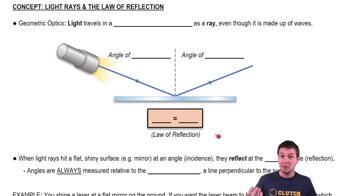
Reflection of light occurs when light rays bounce off a surface, such as a mirror. The angle of incidence, which is the angle between the incoming ray and the normal (a perpendicular line to the surface), equals the angle of reflection. This principle allows us to see images in mirrors, as light reflects off the surface and travels to our eyes, creating the perception of depth and distance.
추천 영상:
가이드 코스
06:25
Law of Reflection

Virtual Images

A virtual image is formed when light rays appear to diverge from a point behind a mirror, rather than converging at that point. In the case of parallel mirrors, the virtual images of objects can appear at various distances depending on the position of the object relative to the mirrors. This concept is crucial for understanding how the back of your head is perceived when looking into the mirrors.
추천 영상:

Distance Calculation in Mirror Systems

In a system with two parallel mirrors, the distance to the virtual image can be calculated by considering the distances from the object to each mirror. The total distance to the virtual image is effectively double the distance from the object to the nearest mirror, as the light reflects back and forth between the mirrors. This principle helps determine how far away the back of your head appears when viewed in the mirrors.
추천 영상:
가이드 코스
09:03
Mirror Equation
관련 실천
교과서 질문

An object is 12 cm in front of a concave mirror with a focal length of 20 cm. Use ray tracing to locate the image. Is the image upright or inverted?

239
views

교과서 질문

An advanced computer sends information to its various parts via infrared light pulses traveling through silicon fibers. To acquire data from memory, the central processing unit sends a light-pulse request to the memory unit. The memory unit processes the request, then sends a data pulse back to the central processing unit. The memory unit takes 0.5 ns to process a request. If the information has to be obtained from memory in 2.0 ns, what is the maximum distance the memory unit can be from the central processing unit?

74
views
교과서 질문

A light ray in air is incident on a transparent material whose index of refraction is n. Find an expression for the (non-zero) angle of incidence whose angle of refraction is half the angle of incidence.

72
views
교과서 질문

The 80-cm-tall, 65-cm-wide tank shown in FIGURE P34.48 is completely filled with water. The tank has marks every 10 cm along one wall, and the 0 cm mark is barely submerged. As you stand beside the opposite wall, your eye is level with the top of the water. Can you see the marks from the top of the tank (the 0 cm mark) going down, or from the bottom of the tank (the 80 cm mark) coming up? Explain.


103
views
교과서 질문

A horizontal meter stick is centered at the bottom of a 3.0-m-deep, 3.0-m-wide pool of water. Suppose you place your eye just above the edge of the pool and look along the direction of the meter stick. What angle do you observe between the two ends of the meter stick if the pool is (a) empty and (b) completely filled with water?

71
views
교과서 질문

A red ball is placed at point A in FIGURE P34.44. What are the (x, y) coordinates of each image?

141
views