Ch 36: Special Relativity
Knight Calc - Physics for Scientists and Engineers 5th Edition
Knight Calc5th EditionPhysics for Scientists and EngineersISBN: 9780137344796당신이 사용하는 게 아니라요?교과서 변경
36장, 문제 14

A cosmic ray travels 60 km through the earth's atmosphere in 400 μs, as measured by experimenters on the ground. How long does the journey take according to the cosmic ray?

검증된 단계별 안내
1
Step 1: Identify the concept involved in the problem. This is a relativistic problem involving time dilation, which occurs when an object moves at a significant fraction of the speed of light. The time experienced by the cosmic ray (proper time) is shorter than the time measured by observers on the ground due to its high velocity.
Step 2: Write down the formula for time dilation: t=t0/1-v²/c², where t is the time measured by the ground observers, t0 is the proper time experienced by the cosmic ray, v is the velocity of the cosmic ray, and c is the speed of light.
Step 3: Rearrange the formula to solve for the proper time t0: t0=t×1-v²/c². Substitute the given values: t = 400 μs, and calculate v using the distance traveled (60 km) and the time measured by the ground observers.
Step 4: Calculate the velocity of the cosmic ray: v=d/t, where d is the distance (60 km converted to meters) and t is the time (400 μs converted to seconds). Ensure the units are consistent before performing the calculation.
Step 5: Substitute the calculated velocity v and the speed of light c (approximately 3 × 10⁸ m/s) into the time dilation formula to find the proper time t0. This will give the time experienced by the cosmic ray during its journey.

비슷한 문제에 대한 검증된 영상 답변:

이 영상 해법은 위 문제에 도움이 된다고 튜터들이 추천한 것입니다.
도움이 되었나요?

주요 개념

질문에 올바르게 답하기 위해 반드시 이해해야 하는 핵심 개념들은 다음과 같습니다.

Time Dilation

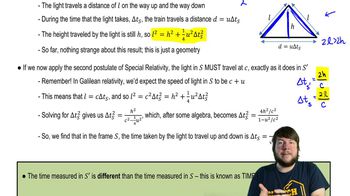
Time dilation is a phenomenon predicted by Einstein's theory of relativity, where time is observed to pass at different rates for observers in different frames of reference. For objects moving at speeds close to the speed of light, such as cosmic rays, time appears to pass more slowly compared to stationary observers. This concept is crucial for understanding how the cosmic ray perceives its travel time compared to the time measured by experimenters on the ground.
추천 영상:

Lorentz Factor

The Lorentz factor is a mathematical factor that arises in the equations of special relativity, defined as γ = 1 / √(1 - v²/c²), where v is the velocity of the moving object and c is the speed of light. This factor quantifies the effects of time dilation and length contraction experienced by objects moving at relativistic speeds. It is essential for calculating how much time elapses for the cosmic ray compared to the time measured by stationary observers.
추천 영상:
가이드 코스
14:16
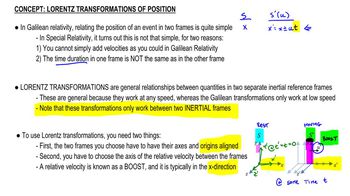
Lorentz Transformations of Position

Relativistic Speeds

Relativistic speeds refer to velocities that are a significant fraction of the speed of light (approximately 3 x 10^8 m/s). At these speeds, classical mechanics no longer accurately describes motion, and relativistic effects, such as time dilation and length contraction, become significant. Understanding these speeds is vital for analyzing the behavior of cosmic rays as they travel through the atmosphere and how their experiences differ from those of observers on Earth.
추천 영상:
가이드 코스
07:59
Speed Distribution & Special Speeds of Ideal Gases