
Ch 36: Special Relativity
Knight Calc - Physics for Scientists and Engineers 5th Edition
Knight Calc5th EditionPhysics for Scientists and EngineersISBN: 9780137344796당신이 사용하는 게 아니라요?교과서 변경
36장, 문제 21

Jill claims that her new rocket is 100 m long. As she flies past your house, you measure the rocket’s length and find that it is only 80 m. What is Jill’s speed, as a fraction of c?

검증된 단계별 안내
1
Step 1: Recognize that this problem involves the concept of length contraction, which is a phenomenon described by Einstein's theory of special relativity. Length contraction occurs when an object moves at a significant fraction of the speed of light (c) relative to an observer.
Step 2: Use the length contraction formula: L = L₀ √(1 - v²/c²), where L is the contracted length observed (80 m), L₀ is the proper length (100 m), v is the speed of the rocket, and c is the speed of light.
Step 3: Rearrange the formula to solve for the speed v as a fraction of c. Start by dividing both sides of the equation by L₀: L/L₀ = √(1 - v²/c²). Then square both sides to eliminate the square root: (L/L₀)² = 1 - v²/c².
Step 4: Isolate the term v²/c² by subtracting (L/L₀)² from 1: v²/c² = 1 - (L/L₀)². Then take the square root of both sides to solve for v/c: v/c = √[1 - (L/L₀)²].
Step 5: Substitute the given values into the equation. L₀ = 100 m and L = 80 m, so v/c = √[1 - (80/100)²]. Simplify the fraction and calculate the result to find Jill's speed as a fraction of c.

비슷한 문제에 대한 검증된 영상 답변:

이 영상 해법은 위 문제에 도움이 된다고 튜터들이 추천한 것입니다.
도움이 되었나요?

주요 개념

질문에 올바르게 답하기 위해 반드시 이해해야 하는 핵심 개념들은 다음과 같습니다.

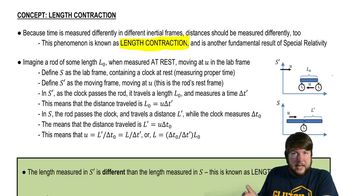
Length Contraction

Length contraction is a phenomenon predicted by Einstein's theory of special relativity, where the length of an object moving at a significant fraction of the speed of light appears shorter to an observer at rest. This effect becomes noticeable as the object's speed approaches the speed of light (c), leading to discrepancies between the proper length (the length measured in the object's rest frame) and the length measured by an observer in motion relative to the object.
추천 영상:
가이드 코스
07:02
Length Contraction

Relativistic Speed

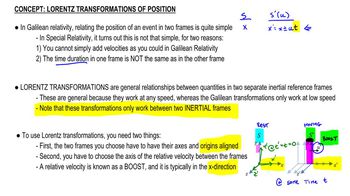
Relativistic speed refers to speeds that are a significant fraction of the speed of light (c). At these speeds, classical mechanics no longer accurately describes motion, and relativistic effects, such as time dilation and length contraction, must be considered. To calculate an object's speed as a fraction of c, one must use the Lorentz transformation equations, which relate the measurements of time and space between different inertial frames.
추천 영상:
가이드 코스
07:59
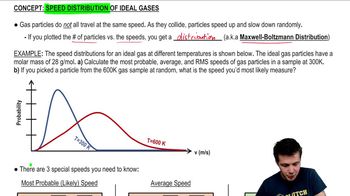
Speed Distribution & Special Speeds of Ideal Gases

Lorentz Factor

The Lorentz factor (γ) is a crucial component in special relativity that quantifies the effects of relativistic speeds on time, length, and relativistic mass. It is defined as γ = 1 / √(1 - v²/c²), where v is the object's speed and c is the speed of light. This factor is used to calculate how much time dilates and lengths contract as an object approaches the speed of light, allowing for the determination of the observed length of moving objects.
추천 영상:
가이드 코스
14:16
Lorentz Transformations of Position