Ch 36: Special Relativity
Knight Calc - Physics for Scientists and Engineers 5th Edition
Knight Calc5th EditionPhysics for Scientists and EngineersISBN: 9780137344796당신이 사용하는 게 아니라요?교과서 변경
36장, 문제 63a

A rocket is fired from the earth to the moon at a speed of 0.990c. Let two events be 'rocket leaves earth' and 'rocket hits moon.' In the earth's reference frame, calculate ∆x, ∆t, and the spacetime interval s for these events.

검증된 단계별 안내
1
Step 1: Identify the given values and the quantities to calculate. The rocket's speed is given as 0.990c (where c is the speed of light). The two events are 'rocket leaves earth' and 'rocket hits moon.' In the Earth's reference frame, the distance between the Earth and the Moon (∆x) is approximately 384,400 km. The time interval (∆t) can be calculated using the formula for time: ∆t = ∆x / v, where v is the rocket's speed.
Step 2: Calculate the spatial separation (∆x). Since the problem specifies the Earth's reference frame, the spatial separation is simply the distance between the Earth and the Moon, which is approximately 384,400 km. Convert this distance into meters for consistency with SI units: ∆x = 384,400 × 10³ m.
Step 3: Calculate the time interval (∆t). Use the formula ∆t = ∆x / v, where v = 0.990c. Substitute the values: ∆t = (384,400 × 10³ m) / (0.990 × c). Remember that c = 3.00 × 10⁸ m/s. Perform the division to express ∆t in seconds.
Step 4: Calculate the spacetime interval (s). The spacetime interval is given by the formula: s² = (c∆t)² - (∆x)². Substitute the values for ∆t and ∆x into the equation. Be careful to square each term and ensure the units are consistent. Then, take the square root of s² to find s.
Step 5: Interpret the result. The spacetime interval (s) is an invariant quantity, meaning it is the same in all inertial reference frames. This value provides insight into the relationship between the spatial and temporal separations of the two events in spacetime.

비슷한 문제에 대한 검증된 영상 답변:

이 영상 해법은 위 문제에 도움이 된다고 튜터들이 추천한 것입니다.
도움이 되었나요?

주요 개념

질문에 올바르게 답하기 위해 반드시 이해해야 하는 핵심 개념들은 다음과 같습니다.

Relativity of Simultaneity

In the theory of relativity, the simultaneity of events can differ depending on the observer's frame of reference. This means that two events that are simultaneous in one frame may not be simultaneous in another. Understanding this concept is crucial for analyzing events like a rocket leaving Earth and hitting the Moon, as the timing and spatial separation of these events can vary based on the observer's motion.
추천 영상:
가이드 코스
04:27
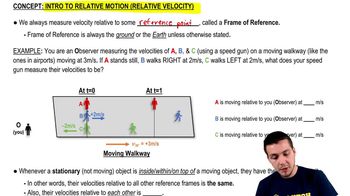
Intro to Relative Motion (Relative Velocity)

Spacetime Interval

The spacetime interval is a measure that combines both spatial and temporal separation between two events in a way that is invariant across different reference frames. It is calculated using the formula s² = c²(∆t)² - (∆x)², where c is the speed of light, ∆t is the time difference, and ∆x is the spatial distance. This concept is essential for understanding how events are related in spacetime, especially in relativistic contexts.
추천 영상:
가이드 코스
07:29
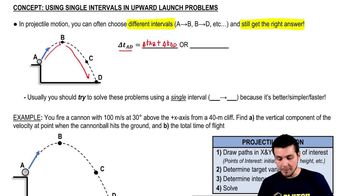
Using Single Intervals in Positive Launch Problems

Lorentz Transformation

The Lorentz transformation equations relate the coordinates of events as observed in different inertial frames moving at a constant velocity relative to each other. These transformations account for the effects of time dilation and length contraction, which are fundamental in special relativity. They allow us to calculate how time intervals and distances change for observers in different frames, which is necessary for solving the problem of the rocket's journey.
추천 영상:
가이드 코스
13:39
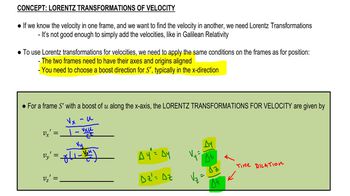
Lorentz Transformations of Velocity
관련 실천
교과서 질문

The half-life of a muon at rest is 1.5 μs. Muons that have been accelerated to a very high speed and are then held in a circular storage ring have a half-life of 7.5 μs. What is the total energy of a muon in the storage ring? The mass of a muon is 207 times the mass of an electron.

115
views
교과서 질문

Let's examine whether or not the law of conservation of momentum is true in all reference frames if we use the Newtonian definition of momentum: px = mux. Consider an object A of mass 3m at rest in reference frame S. Object A explodes into two pieces: object B, of mass m, that is shot to the left at a speed of c/2 and object C, of mass 2m, that, to conserve momentum, is shot to the right at a speed of c/4. Suppose this explosion is observed in reference frame S' that is moving to the right at half the speed of light. Use the Lorentz velocity transformation to find the velocities and the Newtonian momenta of B and C in S'.

114
views
교과서 질문

Derive a velocity transformation equation for uy and u'y. Assume that the reference frames are in the standard orientation with motion parallel to the x- and x'-axes.

117
views
교과서 질문

Two rockets approach each other. Each is traveling at 0.75c in the earth's reference frame. What is the speed, as a fraction of c, of one rocket relative to the other?

1292
views
교과서 질문

A rocket is fired from the earth to the moon at a speed of 0.990c. Let two events be 'rocket leaves earth' and 'rocket hits moon.' Repeat your calculations of part a if the rocket is replaced with a laser beam.

46
views
교과서 질문

At what speed, as a fraction of c, is the kinetic energy of a particle twice its Newtonian value?

95
views