Ch 36: Special Relativity
Knight Calc - Physics for Scientists and Engineers 5th Edition
Knight Calc5th EditionPhysics for Scientists and EngineersISBN: 9780137344796당신이 사용하는 게 아니라요?교과서 변경
36장, 문제 54

Two rockets approach each other. Each is traveling at 0.75c in the earth's reference frame. What is the speed, as a fraction of c, of one rocket relative to the other?

검증된 단계별 안내
1
Step 1: Recognize that this problem involves relative velocity in the context of special relativity. The classical formula for relative velocity does not apply when speeds are close to the speed of light. Instead, use the relativistic velocity addition formula: v_{rel} = \(\frac{v_1 + v_2}{1 + \frac{v_1 v_2}{c^2}\)}, where v_1 and v_2 are the velocities of the two objects in the same reference frame, and c is the speed of light.
Step 2: Assign the given values to the formula. In the earth's reference frame, both rockets are traveling at 0.75c, but in opposite directions. To account for this, one velocity will be positive (v_1 = 0.75c) and the other negative (v_2 = -0.75c).
Step 3: Substitute v_1 = 0.75c and v_2 = -0.75c into the relativistic velocity addition formula: v_{rel} = \(\frac{0.75c - 0.75c}{1 - \frac{(0.75c)(-0.75c)}{c^2}\)}.
Step 4: Simplify the numerator and denominator of the formula. The numerator becomes 1.5c, and the denominator involves the product of 0.75 \(\times\) 0.75, divided by c^2. Carefully simplify the denominator to ensure accuracy.
Step 5: After simplifying, the result will yield the relative velocity v_{rel} as a fraction of c. This fraction represents the speed of one rocket relative to the other in the earth's reference frame.

비슷한 문제에 대한 검증된 영상 답변:

이 영상 해법은 위 문제에 도움이 된다고 튜터들이 추천한 것입니다.
영상 길이:
6m
도움이 되었나요?

주요 개념

질문에 올바르게 답하기 위해 반드시 이해해야 하는 핵심 개념들은 다음과 같습니다.

Relativistic Velocity Addition

In special relativity, the formula for adding velocities differs from classical mechanics. When two objects move at relativistic speeds (close to the speed of light), their relative velocity is calculated using the formula: v' = (u + v) / (1 + uv/c²), where u and v are the velocities of the two objects, and c is the speed of light. This ensures that the resultant speed never exceeds the speed of light.
추천 영상:
7:27
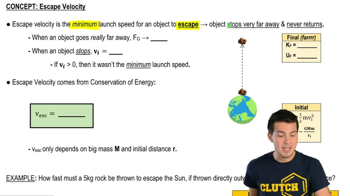
Escape Velocity

Reference Frames

A reference frame is a perspective from which motion is observed and measured. In this problem, the Earth serves as the reference frame for the rockets' speeds. Understanding how different reference frames affect the perception of speed is crucial in relativity, as speeds can appear different depending on the observer's frame of reference.
추천 영상:
14:10
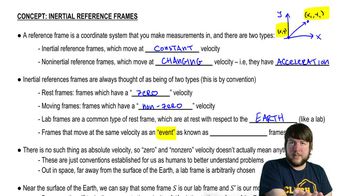
Inertial Reference Frames

Speed of Light (c)

The speed of light in a vacuum, denoted as c, is a fundamental constant in physics, approximately 3.00 x 10^8 meters per second. It serves as the ultimate speed limit in the universe, meaning no object with mass can reach or exceed this speed. In relativistic physics, speeds are often expressed as fractions of c to simplify calculations and comparisons.
추천 영상:
06:03
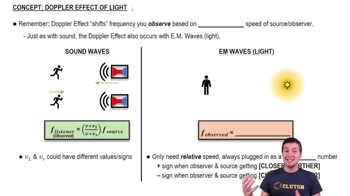
The Doppler Effect (Light)
관련 실천
교과서 질문

A rocket is fired from the earth to the moon at a speed of 0.990c. Let two events be 'rocket leaves earth' and 'rocket hits moon.' In the earth's reference frame, calculate ∆x, ∆t, and the spacetime interval s for these events.

52
views

교과서 질문

The half-life of a muon at rest is 1.5 μs. Muons that have been accelerated to a very high speed and are then held in a circular storage ring have a half-life of 7.5 μs. What is the total energy of a muon in the storage ring? The mass of a muon is 207 times the mass of an electron.

115
views
교과서 질문

Derive a velocity transformation equation for uy and u'y. Assume that the reference frames are in the standard orientation with motion parallel to the x- and x'-axes.

117
views
교과서 질문

The quantity dE/dv, the rate of increase of energy with speed, is the amount of additional energy a moving object needs per 1 m/s increase in speed. A 25,000 kg rocket is traveling at 0.90c. How much additional energy is needed to increase its speed by 1 m/s?

80
views
교과서 질문

A rocket traveling at 0.50c sets out for the nearest star, Alpha Centauri, which is 4.3 ly away from earth. It will return to earth immediately after reaching Alpha Centauri. What distance will the rocket travel and how long will the journey last according to (a) stay-at-home earthlings and (b) the rocket crew? (c) Which answers are the correct ones, those in part a or those in part b?

44
views
교과서 질문

The star Delta goes supernova. One year later and 2.0 ly away, as measured by astronomers in the galaxy, star Epsilon explodes. Let the explosion of Delta be at xD = 0 and tD = 0. The explosions are observed by three spaceships cruising through the galaxy in the direction from Delta to Epsilon at velocities v1 = 0.30c, v2 = 0.50c, and v3 = 0.70c. All three spaceships, each at the origin of its reference frame, happen to pass Delta as it explodes. What are the times of the two explosions as measured by scientists on each of the three spaceships?

99
views