Ch 37: The Foundations of Modern Physics
Knight Calc - Physics for Scientists and Engineers 5th Edition
Knight Calc5th EditionPhysics for Scientists and EngineersISBN: 9780137344796당신이 사용하는 게 아니라요?교과서 변경
37장, 문제 18

A parallel-plate capacitor with a 1.0 mm plate separation is charged to 75 V. With what kinetic energy, in eV, must a proton be launched from the negative plate if it is just barely able to reach the positive plate?

검증된 단계별 안내
1
Understand the problem: A proton is launched from the negative plate of a parallel-plate capacitor and just barely reaches the positive plate. The work done on the proton by the electric field equals the proton's initial kinetic energy. The goal is to find this kinetic energy in electron volts (eV).
Recall the relationship between electric potential difference (V), charge (q), and work (W): \( W = q \cdot V \). Here, \( q \) is the charge of the proton (\( 1.6 \times 10^{-19} \; C \)) and \( V \) is the potential difference (75 V). The work done on the proton is equal to its initial kinetic energy.
Convert the kinetic energy from joules to electron volts (eV). Since 1 eV is defined as the energy gained by a charge of \( 1.6 \times 10^{-19} \; C \) when it moves through a potential difference of 1 V, the kinetic energy in eV is numerically equal to the potential difference in volts.
Summarize: The proton's initial kinetic energy in eV is equal to the potential difference (75 V) because the charge of the proton is 1 elementary charge. This is a direct result of the definition of the electron volt.
Verify: Ensure the units are consistent and the reasoning aligns with the physical principles of energy conservation and electric potential.

비슷한 문제에 대한 검증된 영상 답변:

이 영상 해법은 위 문제에 도움이 된다고 튜터들이 추천한 것입니다.
영상 길이:
6m
도움이 되었나요?

주요 개념

질문에 올바르게 답하기 위해 반드시 이해해야 하는 핵심 개념들은 다음과 같습니다.

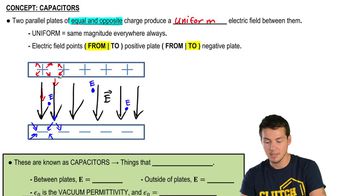
Electric Field in Capacitors

The electric field (E) between the plates of a parallel-plate capacitor is uniform and can be calculated using the formula E = V/d, where V is the voltage and d is the separation between the plates. In this case, with a voltage of 75 V and a plate separation of 1.0 mm, the electric field strength is crucial for determining the force acting on the proton as it moves through the field.
추천 영상:
06:13
Intro to Capacitors

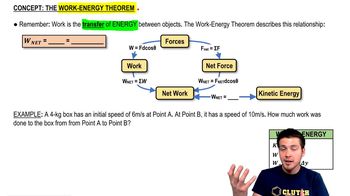
Work-Energy Principle

The work-energy principle states that the work done on an object is equal to the change in its kinetic energy. For a proton moving in an electric field, the work done by the electric field on the proton as it moves from the negative to the positive plate translates into kinetic energy. This relationship is essential for calculating the kinetic energy required for the proton to just reach the positive plate.
추천 영상:
04:10
The Work-Energy Theorem

Kinetic Energy of a Charged Particle

The kinetic energy (KE) of a charged particle, such as a proton, can be expressed in electronvolts (eV) when considering its motion in an electric field. The kinetic energy gained by the proton as it moves through the electric field is equal to the product of the charge of the proton and the potential difference it moves through. This concept is key to determining the energy needed for the proton to barely reach the positive plate.
추천 영상:
06:07
Intro to Rotational Kinetic Energy