Ch 37: The Foundations of Modern Physics
Knight Calc - Physics for Scientists and Engineers 5th Edition
Knight Calc5th EditionPhysics for Scientists and EngineersISBN: 9780137344796당신이 사용하는 게 아니라요?교과서 변경
37장, 문제 16a

Express in eV (or keV or MeV if more appropriate): The kinetic energy of an electron moving with a speed of 5.0 x 10⁶ m/s .

검증된 단계별 안내
1
Step 1: Recall the formula for kinetic energy, which is given by \( KE = \frac{1}{2}mv^2 \), where \( m \) is the mass of the electron and \( v \) is its velocity.
Step 2: Substitute the known values into the formula. The mass of an electron \( m \) is approximately \( 9.11 \times 10^{-31} \; \text{kg} \), and the velocity \( v \) is given as \( 5.0 \times 10^6 \; \text{m/s} \).
Step 3: Calculate the kinetic energy in joules using the formula \( KE = \frac{1}{2}mv^2 \). This involves squaring the velocity, multiplying by the mass, and then dividing by 2.
Step 4: Convert the kinetic energy from joules to electronvolts (eV). Use the conversion factor \( 1 \; \text{eV} = 1.602 \times 10^{-19} \; \text{J} \). Divide the kinetic energy in joules by this factor to express it in eV.
Step 5: If the resulting value is very large or very small, express it in keV (\( 1 \; \text{keV} = 10^3 \; \text{eV} \)) or MeV (\( 1 \; \text{MeV} = 10^6 \; \text{eV} \)) for convenience.

비슷한 문제에 대한 검증된 영상 답변:

이 영상 해법은 위 문제에 도움이 된다고 튜터들이 추천한 것입니다.

주요 개념

질문에 올바르게 답하기 위해 반드시 이해해야 하는 핵심 개념들은 다음과 같습니다.

Kinetic Energy

Kinetic energy is the energy an object possesses due to its motion, calculated using the formula KE = 0.5 * m * v², where m is the mass and v is the velocity of the object. For an electron, this energy can be expressed in electronvolts (eV), a unit commonly used in particle physics to represent small energy values.
추천 영상:
가이드 코스
06:07
Intro to Rotational Kinetic Energy

Mass of an Electron

The mass of an electron is approximately 9.11 x 10⁻³¹ kg. This small mass is crucial for calculating the kinetic energy of the electron when it is moving at high speeds, as even small changes in velocity can result in significant changes in kinetic energy due to the squared term in the kinetic energy formula.
추천 영상:
가이드 코스
20:32
Mass Spectrometers

Conversion to Electronvolts

Electronvolts (eV) are a unit of energy defined as the amount of kinetic energy gained by an electron when it is accelerated through an electric potential difference of one volt. To convert kinetic energy from joules to electronvolts, one can use the conversion factor 1 eV = 1.602 x 10⁻¹⁹ joules, allowing for easier interpretation of energy values in the context of atomic and subatomic processes.
추천 영상:
가이드 코스
05:37
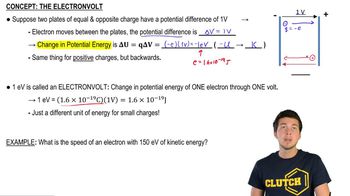
The ElectronVolt
관련 실천
교과서 질문

A parallel-plate capacitor with a 1.0 mm plate separation is charged to 75 V. With what kinetic energy, in eV, must a proton be launched from the negative plate if it is just barely able to reach the positive plate?

1420
views

교과서 질문

A 0.80-μm-diameter oil droplet is observed between two parallel electrodes spaced 11 mm apart. The droplet hangs motionless if the upper electrode is 20 V more positive than the lower electrode. The density of the oil is 885 kg/m3. Does the droplet have a surplus or a deficit of electrons? How many?

1556
views
교과서 질문

How many electrons, protons, and neutrons are contained in the following atoms or ions: (a) ¹⁰B, (b) ¹³N⁺, and (c) ¹⁷O⁺⁺⁺?

1313
views
교과서 질문

An electron in a cathode-ray beam passes between 2.5-cm-long parallel-plate electrodes that are 5.0 mm apart. A 2.0 mT, 2.5-cm-wide magnetic field is perpendicular to the electric field between the plates. The electron passes through the electrodes without being deflected if the potential difference between the plates is 600 V. If the potential difference between the plates is set to zero, what is the electron's radius of curvature in the magnetic field?

329
views
교과서 질문

Determine the speed of a 15 MeV helium atom.

166
views
교과서 질문

Identify the isotope that is 11 times as heavy as ¹²C and has 18 times as many protons as ⁶Li . Give your answer in the form ᴬS, where S is the symbol for the element. See Appendix C: Atomic and Nuclear Data.

1087
views