Ch 38: Quantization
Knight Calc - Physics for Scientists and Engineers 5th Edition
Knight Calc5th EditionPhysics for Scientists and EngineersISBN: 9780137344796당신이 사용하는 게 아니라요?교과서 변경
38장, 문제 47b

INT The electron interference pattern of Figure 38.12 was made by shooting electrons with 50 keV of kinetic energy through two slits spaced 1.0 μm apart. The fringes were recorded on a detector 1.0 m behind the slits. Figure 38.12 is greatly magnified. What was the actual spacing on the detector between adjacent bright fringes?

검증된 단계별 안내
1
Determine the wavelength of the electrons using the de Broglie wavelength formula: λ = h / p, where h is Planck's constant (6.626 × 10⁻³⁴ J·s) and p is the momentum of the electron. The momentum can be calculated using p = √(2mE), where m is the mass of the electron (9.11 × 10⁻³¹ kg) and E is the kinetic energy of the electron (50 keV, converted to joules).
Calculate the angular separation (θ) between adjacent bright fringes using the double-slit interference condition: d sin(θ) = mλ, where d is the slit separation (1.0 μm), m is the fringe order (m = 1 for adjacent fringes), and λ is the wavelength of the electrons.
For small angles (θ), use the approximation sin(θ) ≈ tan(θ) ≈ θ (in radians). The angular separation θ can then be related to the fringe spacing (Δy) on the detector by the formula: θ = Δy / L, where L is the distance from the slits to the detector (1.0 m).
Rearrange the formula to solve for the fringe spacing: Δy = θ × L. Substitute the value of θ obtained from the previous step and the given value of L to find Δy.
Ensure all units are consistent throughout the calculations (e.g., convert μm to meters and keV to joules) and verify the final expression for Δy represents the spacing between adjacent bright fringes on the detector.

비슷한 문제에 대한 검증된 영상 답변:

이 영상 해법은 위 문제에 도움이 된다고 튜터들이 추천한 것입니다.
도움이 되었나요?

주요 개념

질문에 올바르게 답하기 위해 반드시 이해해야 하는 핵심 개념들은 다음과 같습니다.

Wave-Particle Duality

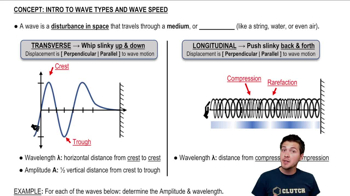
Wave-particle duality is a fundamental concept in quantum mechanics that describes how particles, such as electrons, exhibit both wave-like and particle-like properties. In the context of the double-slit experiment, electrons create an interference pattern, which is characteristic of waves, despite being particles. This duality is essential for understanding phenomena like electron interference.
추천 영상:
가이드 코스
07:19
Intro to Waves and Wave Speed

Interference Pattern

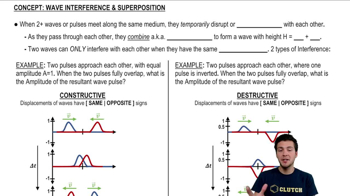
An interference pattern occurs when waves overlap and combine, resulting in regions of constructive and destructive interference. In the double-slit experiment, electrons passing through two slits create a pattern of alternating bright and dark fringes on a detector. The spacing of these fringes is influenced by the wavelength of the electrons and the geometry of the slits.
추천 영상:
가이드 코스
03:47
Wave Interference & Superposition

Kinetic Energy and Wavelength

The kinetic energy of a particle is related to its wavelength through the de Broglie hypothesis, which states that the wavelength is inversely proportional to the momentum of the particle. For electrons with a kinetic energy of 50 keV, this relationship allows us to calculate the wavelength, which is crucial for determining the spacing of the interference fringes on the detector.
추천 영상:
가이드 코스
06:07
Intro to Rotational Kinetic Energy