
Ch 38: Quantization
Knight Calc - Physics for Scientists and Engineers 5th Edition
Knight Calc5th EditionPhysics for Scientists and EngineersISBN: 9780137344796당신이 사용하는 게 아니라요?교과서 변경
38장, 문제 42a

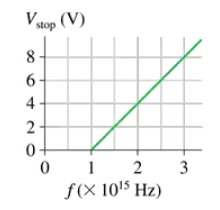
The graph in FIGURE P38.42 was measured in a photoelectric-effect experiment. What is the work function (in eV) of the cathode?

검증된 단계별 안내
1
Step 1: Understand the photoelectric effect equation, which is given by \( eV_{\text{stop}} = hf - \phi \), where \( V_{\text{stop}} \) is the stopping potential, \( h \) is Planck's constant, \( f \) is the frequency of the incident light, and \( \phi \) is the work function of the material.
Step 2: Analyze the graph provided. The graph shows \( V_{\text{stop}} \) (stopping potential) on the y-axis and \( f \) (frequency) on the x-axis. The linear relationship indicates that \( V_{\text{stop}} \) increases with frequency.
Step 3: Identify the threshold frequency \( f_{\text{threshold}} \) from the graph. This is the frequency at which \( V_{\text{stop}} = 0 \). From the graph, \( f_{\text{threshold}} \) appears to be approximately \( 1 \times 10^{15} \, \text{Hz} \).
Step 4: Use the relationship \( \phi = hf_{\text{threshold}} \) to calculate the work function. Here, \( h \) is Planck's constant, \( h = 6.626 \times 10^{-34} \, \text{J·s} \). Convert \( \phi \) to electron volts (eV) using the conversion factor \( 1 \, \text{eV} = 1.602 \times 10^{-19} \, \text{J} \).
Step 5: Substitute \( f_{\text{threshold}} \) and \( h \) into the equation \( \phi = hf_{\text{threshold}} \) and perform the unit conversion to express the work function in eV. This will give the final value of \( \phi \).

비슷한 문제에 대한 검증된 영상 답변:

이 영상 해법은 위 문제에 도움이 된다고 튜터들이 추천한 것입니다.
도움이 되었나요?

주요 개념

질문에 올바르게 답하기 위해 반드시 이해해야 하는 핵심 개념들은 다음과 같습니다.

Photoelectric Effect

The photoelectric effect is the phenomenon where electrons are emitted from a material, typically a metal, when it is exposed to light of sufficient frequency. This effect demonstrates the particle nature of light, as photons must have enough energy to overcome the work function of the material to release electrons. The relationship between the frequency of incident light and the kinetic energy of emitted electrons is crucial for understanding this effect.
추천 영상:
가이드 코스
07:40
The Doppler Effect

Work Function

The work function is the minimum energy required to remove an electron from the surface of a material. It is a critical parameter in the photoelectric effect, as it determines the threshold frequency below which no electrons are emitted, regardless of the intensity of the light. The work function is typically expressed in electronvolts (eV) and can be calculated from the intercept of the graph of stopping potential versus frequency.
추천 영상:
가이드 코스
08:30
Intro to Wave Functions

Stopping Potential

Stopping potential is the voltage needed to stop the most energetic photoelectrons emitted from a material in a photoelectric experiment. It is directly related to the kinetic energy of the emitted electrons, which can be calculated using the equation KE = eV_stop, where e is the charge of an electron. The stopping potential is plotted against the frequency of the incident light to determine the work function and analyze the photoelectric effect.
추천 영상:
가이드 코스
07:12
Distance to Stop a Point Charge
관련 실천
교과서 질문

INT The electron interference pattern of Figure 38.12 was made by shooting electrons with 50 keV of kinetic energy through two slits spaced 1.0 μm apart. The fringes were recorded on a detector 1.0 m behind the slits. Figure 38.12 is greatly magnified. What was the actual spacing on the detector between adjacent bright fringes?

103
views
교과서 질문

Potassium and gold cathodes are used in a photoelectric-effect experiment. For each cathode, find: The threshold frequency.

625
views
교과서 질문

Potassium and gold cathodes are used in a photoelectric-effect experiment. For each cathode, find: The stopping potential if the wavelength is 220 nm.

180
views
교과서 질문

The cosmic microwave background radiation is light left over from the Big Bang that has been Doppler-shifted to microwave frequencies by the expansion of the universe. It now fills the universe with 450 photons/cm3 at an average frequency of 160 GHz. How much energy from the cosmic microwave background, in MeV, fills a small apartment that has 95 m2 of floor space and 2.5-m-high ceilings?

53
views
교과서 질문

A 75 kW radio transmitter emits 550 kHz radio waves uniformly in all directions. At what rate do photons strike a 1.5-m-tall, 3.0-mm-diameter antenna that is 15 km away?

132
views
교과서 질문

BIO The wavelengths of light emitted by a firefly span the visible spectrum but have maximum intensity near 550 nm. A typical flash lasts for 100 ms and has a power output of 1.2 mW. How many photons does a firefly emit in one flash if we assume that all light is emitted at the peak intensity wavelength of 550 nm?

645
views