Ch 38: Quantization
Knight Calc - Physics for Scientists and Engineers 5th Edition
Knight Calc5th EditionPhysics for Scientists and EngineersISBN: 9780137344796당신이 사용하는 게 아니라요?교과서 변경
38장, 문제 67

INT Two hydrogen atoms collide head-on. The collision brings both atoms to a halt. Immediately after the collision, both atoms emit a 121.6 nm photon. What was the speed of each atom just before the collision?

검증된 단계별 안내
1
Determine the energy of the emitted photon using the formula for photon energy: E=hc/λ, where h is Planck's constant, c is the speed of light, and λ is the wavelength of the photon (121.6 nm).
Recognize that the total energy of the system before the collision is equal to the total energy after the collision due to conservation of energy. The kinetic energy of the two hydrogen atoms before the collision is converted into the energy of the emitted photons.
Write the expression for the total kinetic energy of the two hydrogen atoms before the collision: K=12mv2+12mv2, where m is the mass of a hydrogen atom and v is the speed of each atom (since they are identical).
Set the total kinetic energy of the two atoms equal to the total energy of the two emitted photons: 212mv2=2E. Simplify this equation to solve for v.
Substitute the known values for E, m (mass of a hydrogen atom), and constants (h, c, and λ) into the equation to calculate the speed v of each hydrogen atom before the collision.

비슷한 문제에 대한 검증된 영상 답변:

이 영상 해법은 위 문제에 도움이 된다고 튜터들이 추천한 것입니다.
영상 길이:
12m
도움이 되었나요?

주요 개념

질문에 올바르게 답하기 위해 반드시 이해해야 하는 핵심 개념들은 다음과 같습니다.

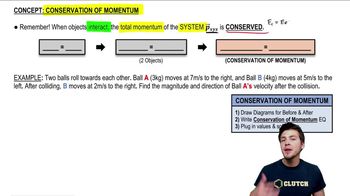
Conservation of Momentum

In a closed system, the total momentum before a collision is equal to the total momentum after the collision. For two hydrogen atoms colliding head-on and coming to a halt, their initial momenta must have been equal and opposite, allowing us to analyze their speeds before the collision based on the final state.
추천 영상:
가이드 코스
05:58
Conservation Of Momentum

Photon Emission and Energy

When the hydrogen atoms collide and come to a stop, they release energy in the form of a photon. The energy of the emitted photon can be calculated using the equation E = hc/λ, where h is Planck's constant, c is the speed of light, and λ is the wavelength of the photon. This energy corresponds to the kinetic energy lost by the atoms during the collision.
추천 영상:
가이드 코스
04:10
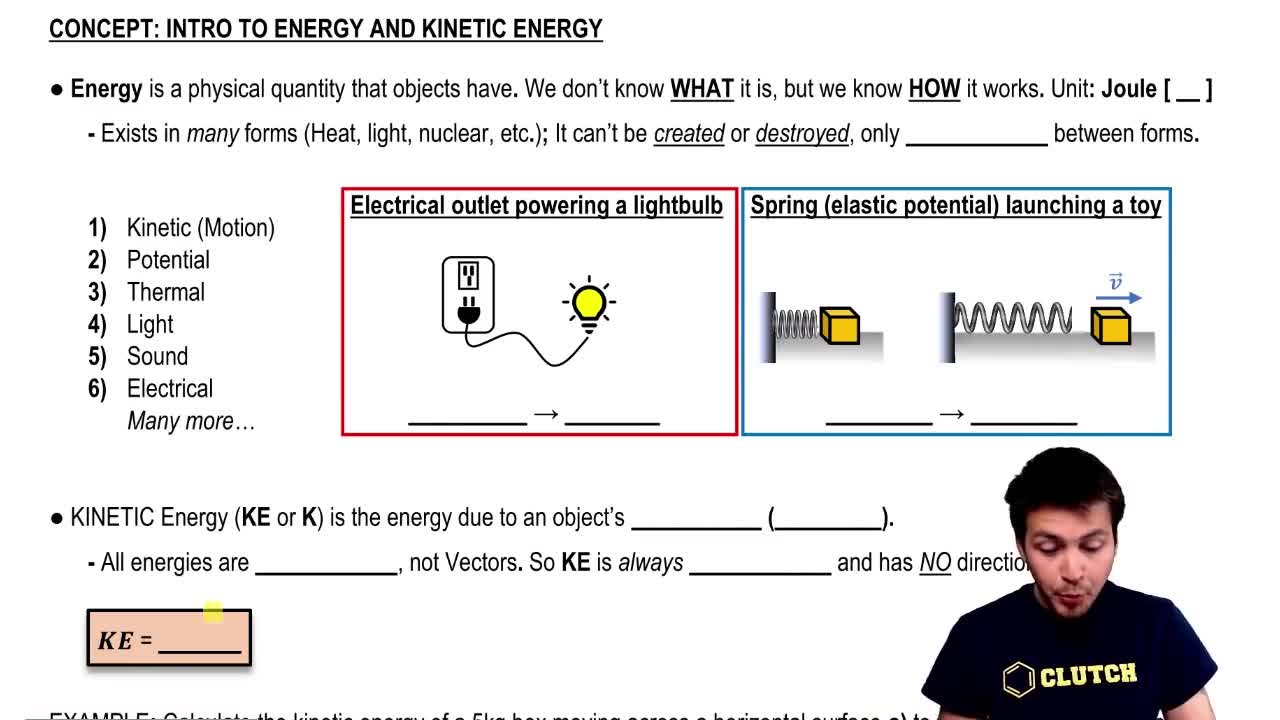
Intro to Energy & Types of Energy

Kinetic Energy

Kinetic energy is the energy an object possesses due to its motion, given by the formula KE = 1/2 mv², where m is mass and v is velocity. In this scenario, the initial kinetic energy of the hydrogen atoms can be equated to the energy of the emitted photon, allowing us to solve for the speed of each atom just before the collision.
추천 영상:
가이드 코스
06:07
Intro to Rotational Kinetic Energy