Ch 38: Quantization
Knight Calc - Physics for Scientists and Engineers 5th Edition
Knight Calc5th EditionPhysics for Scientists and EngineersISBN: 9780137344796당신이 사용하는 게 아니라요?교과서 변경
38장, 문제 69

The electrons in a cathode-ray tube are accelerated through a 250 V potential difference and then shot through a 33-nm-diameter circular aperture. What is the diameter of the bright spot on an electron detector 1.5 m behind the aperture?

검증된 단계별 안내
1
Determine the speed of the electrons after being accelerated through the 250 V potential difference. Use the energy conservation principle: the kinetic energy gained by the electrons is equal to the work done by the electric field. The formula is \( \frac{1}{2}mv^2 = eV \), where \( m \) is the mass of the electron, \( v \) is its velocity, \( e \) is the charge of the electron, and \( V \) is the potential difference.
Calculate the de Broglie wavelength of the electrons using the formula \( \lambda = \frac{h}{mv} \), where \( h \) is Planck's constant, \( m \) is the mass of the electron, and \( v \) is the velocity obtained in the previous step.
Determine the angular width of the central diffraction maximum using the single-slit diffraction formula for electrons: \( \sin \theta = \frac{1.22 \lambda}{D} \), where \( \lambda \) is the de Broglie wavelength, and \( D \) is the diameter of the aperture (33 nm).
Calculate the linear diameter of the bright spot on the detector. The formula is \( d = 2L \tan \theta \), where \( L \) is the distance from the aperture to the detector (1.5 m), and \( \tan \theta \approx \sin \theta \) for small angles.
Substitute all known values into the equations and simplify to find the diameter of the bright spot. Ensure all units are consistent (e.g., convert nm to meters) before performing calculations.

비슷한 문제에 대한 검증된 영상 답변:

이 영상 해법은 위 문제에 도움이 된다고 튜터들이 추천한 것입니다.
도움이 되었나요?

주요 개념

질문에 올바르게 답하기 위해 반드시 이해해야 하는 핵심 개념들은 다음과 같습니다.

Electron Acceleration

When electrons are subjected to a potential difference, they gain kinetic energy proportional to the voltage. In this case, a 250 V potential difference accelerates the electrons, allowing us to calculate their final velocity using the equation KE = eV, where KE is kinetic energy, e is the charge of the electron, and V is the voltage.
추천 영상:
가이드 코스
05:47
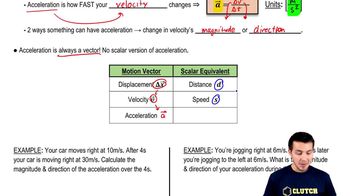
Intro to Acceleration

Wave-Particle Duality

Electrons exhibit both particle-like and wave-like properties, a concept known as wave-particle duality. When electrons pass through the aperture, they can be treated as waves, which leads to diffraction. This behavior is crucial for determining the size of the bright spot on the detector, as it depends on the wavelength of the electrons.
추천 영상:
가이드 코스
07:19
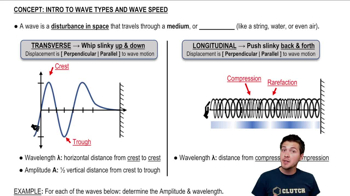
Intro to Waves and Wave Speed

Diffraction and Spot Size

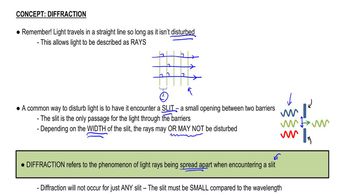
Diffraction occurs when waves encounter an obstacle or aperture, causing them to spread out. The size of the bright spot on the detector can be calculated using the diffraction formula, which relates the aperture size, distance to the detector, and the wavelength of the electrons. This relationship helps predict how the wave nature of electrons affects the observed spot size.
추천 영상:
관련 실천
교과서 질문

INT A beam of electrons is incident upon a gas of hydrogen atoms. Through what potential difference must the electrons be accelerated to have this speed?

111
views

교과서 질문

Consider an electron undergoing cyclotron motion in a magnetic field. According to Bohr, the electron’s angular momentum must be quantized in units of ℏ. Find an expression for the allowed energy levels En in terms of ℏ and the cyclotron frequency fcyc.

126
views
교과서 질문

In the atom interferometer experiment of Figure 38.13, laser-cooling techniques were used to cool a dilute vapor of sodium atoms to a temperature of 0.0010 K=1.0 mK. The ultracold atoms passed through a series of collimating apertures to form the atomic beam you see entering the figure from the left. The standing light waves were created from a laser beam with a wavelength of 590 nm. Because interference is observed between the two paths, each individual atom is apparently present at both point B and point C. Describe, in your own words, what this experiment tells you about the nature of matter.

1442
views
교과서 질문

INT A beam of electrons is incident upon a gas of hydrogen atoms. What minimum speed must the electrons have to cause the emission of 656 nm light from the 3→2 transition of hydrogen?

45
views
교과서 질문

INT Two hydrogen atoms collide head-on. The collision brings both atoms to a halt. Immediately after the collision, both atoms emit a 121.6 nm photon. What was the speed of each atom just before the collision?

1460
views
교과서 질문

Consider an electron undergoing cyclotron motion in a magnetic field. According to Bohr, the electron’s angular momentum must be quantized in units of ℏ. Compute the first four allowed radii in a 1.0 T magnetic field.

121
views