Ch 38: Quantization
Knight Calc - Physics for Scientists and Engineers 5th Edition
Knight Calc5th EditionPhysics for Scientists and EngineersISBN: 9780137344796당신이 사용하는 게 아니라요?교과서 변경
38장, 문제 27b

The allowed energies of a simple atom are 0.00 eV, 4.00 eV, and 6.00 eV. What wavelengths appear in the atom’s emission spectrum?

검증된 단계별 안내
1
Step 1: Understand the problem. The atom has discrete energy levels: 0.00 eV, 4.00 eV, and 6.00 eV. When the atom transitions from a higher energy level to a lower one, it emits a photon. The energy of the photon corresponds to the difference between the two energy levels.
Step 2: Use the relationship between photon energy and wavelength. The energy of a photon is given by the equation: E=hc/λ, where E is the energy of the photon, h is Planck's constant (6.63×1034 J·s), c is the speed of light (3.00×10 m/s), and λ is the wavelength of the photon.
Step 3: Calculate the energy differences between the allowed energy levels. The possible transitions are: (6.00 eV to 4.00 eV), (6.00 eV to 0.00 eV), and (4.00 eV to 0.00 eV). The energy differences are: 2.00 eV, 6.00 eV, and 4.00 eV respectively.
Step 4: Convert the energy differences from electron volts (eV) to joules (J). Use the conversion factor: 1 eV=1.60×10¹⁹ J. For example, 2.00 eV=3.20×10¹⁹ J.
Step 5: Solve for the wavelength λ using the formula λ=hc/E. Substitute the values of h, c, and the energy differences (converted to joules) to calculate the wavelengths for each transition. Ensure the units are consistent throughout the calculation.

비슷한 문제에 대한 검증된 영상 답변:

이 영상 해법은 위 문제에 도움이 된다고 튜터들이 추천한 것입니다.
도움이 되었나요?

주요 개념

질문에 올바르게 답하기 위해 반드시 이해해야 하는 핵심 개념들은 다음과 같습니다.

Energy Levels

In quantum mechanics, energy levels refer to the specific energies that an electron in an atom can occupy. Electrons can only exist in these discrete energy states, and transitions between them result in the absorption or emission of energy in the form of photons. The allowed energies for the atom in the question are 0.00 eV, 4.00 eV, and 6.00 eV, indicating the quantized nature of electron states.
추천 영상:
가이드 코스
04:10
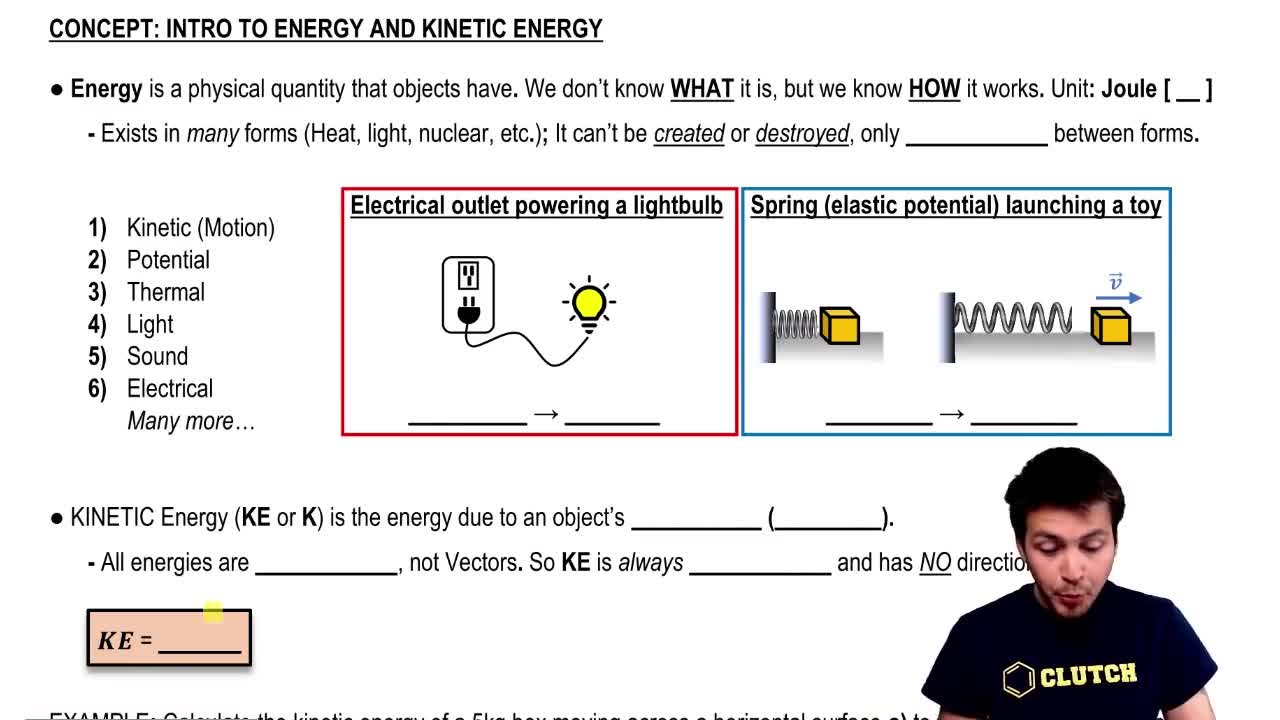
Intro to Energy & Types of Energy

Photon Emission

Photon emission occurs when an electron transitions from a higher energy level to a lower one, releasing energy in the form of a photon. The energy of the emitted photon corresponds to the difference in energy between the two levels. This process is fundamental in understanding atomic spectra, as the wavelengths of emitted light can be calculated from these energy differences.
추천 영상:

Wavelength and Energy Relationship

The relationship between the energy of a photon and its wavelength is described by the equation E = hc/λ, where E is energy, h is Planck's constant, c is the speed of light, and λ is the wavelength. This inverse relationship means that higher energy transitions produce shorter wavelengths. By calculating the energy differences for the allowed transitions, one can determine the corresponding wavelengths in the emission spectrum.
추천 영상:
가이드 코스
03:43
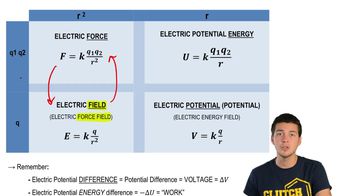
Relationships Between Force, Field, Energy, Potential