Ch 39: Wave Functions and Uncertainty
Knight Calc - Physics for Scientists and Engineers 5th Edition
Knight Calc5th EditionPhysics for Scientists and EngineersISBN: 9780137344796당신이 사용하는 게 아니라요?교과서 변경
39장, 문제 1

An experiment has four possible outcomes, labeled A to D. The probability of A is PA = 40% and of B is PB = 30%. Outcome C is twice as probable as outcome D. What are the probabilities PC and PD?

검증된 단계별 안내
1
Step 1: Start by understanding the problem. You are given probabilities for outcomes A and B, and a relationship between outcomes C and D. The total probability for all outcomes must sum to 100% (or 1 in decimal form).
Step 2: Write the equation for the total probability: Pₐ + PB + PC + PD = 1. Substitute the given values for Pₐ and PB: 0.40 + 0.30 + PC + PD = 1.
Step 3: Use the relationship between outcomes C and D. The problem states that outcome C is twice as probable as outcome D, so PC = 2 × PD.
Step 4: Substitute PC = 2 × PD into the total probability equation: 0.40 + 0.30 + 2 × PD + PD = 1.
Step 5: Combine like terms and solve for PD. Once PD is found, use the relationship PC = 2 × PD to calculate PC.

비슷한 문제에 대한 검증된 영상 답변:

이 영상 해법은 위 문제에 도움이 된다고 튜터들이 추천한 것입니다.
도움이 되었나요?

주요 개념

질문에 올바르게 답하기 위해 반드시 이해해야 하는 핵심 개념들은 다음과 같습니다.

Probability Basics

Probability is a measure of the likelihood that an event will occur, expressed as a number between 0 and 1, or as a percentage. The sum of the probabilities of all possible outcomes in a given experiment must equal 1 (or 100%). Understanding this principle is crucial for solving problems involving multiple outcomes.
추천 영상:
가이드 코스
04:03
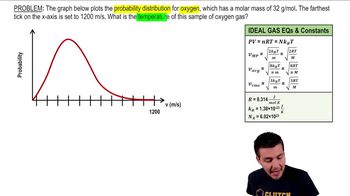
Probability Distribution Graph

Setting Up Equations

In problems involving probabilities, it is often necessary to set up equations based on the relationships between different outcomes. For instance, if one outcome is defined in terms of another (like C being twice as probable as D), this relationship can be expressed mathematically to find unknown probabilities.
추천 영상:
가이드 코스
08:25
Kinematics Equations

Solving for Unknowns

Once the equations are established, solving for unknown probabilities involves algebraic manipulation. This may include substituting known values and simplifying equations to isolate the variable of interest. Mastery of these techniques is essential for determining the probabilities of outcomes in complex scenarios.
추천 영상:
가이드 코스
06:03
Solving an Unknown 2D Force