
Ch 40: One-Dimensional Quantum Mechanics
Knight Calc - Physics for Scientists and Engineers 5th Edition
Knight Calc5th EditionPhysics for Scientists and EngineersISBN: 9780137344796당신이 사용하는 게 아니라요?교과서 변경
40장, 문제 37a

A typical electron in a piece of metallic sodium has energy −E₀ compared to a free electron, where E₀ is the 2.36 eV work function of sodium. At what distance beyond the surface of the metal is the electron’s probability density 10% of its value at the surface?

검증된 단계별 안내
1
Step 1: Understand the problem. The question involves the probability density of an electron outside the surface of metallic sodium. The probability density decreases exponentially with distance from the surface, and we are tasked with finding the distance at which the probability density is 10% of its value at the surface.
Step 2: Recall the relationship between the probability density and the work function. The probability density of the electron outside the surface is proportional to \( e^{-2kz} \), where \( k \) is the wave number and \( z \) is the distance from the surface. The wave number \( k \) is related to the work function \( E_0 \) by \( k = \sqrt{\frac{2mE_0}{\hbar^2}} \), where \( m \) is the mass of the electron and \( \hbar \) is the reduced Planck's constant.
Step 3: Set up the equation for the probability density. The probability density at distance \( z \) is given by \( P(z) = P(0) e^{-2kz} \), where \( P(0) \) is the probability density at the surface. To find the distance \( z \) where \( P(z) = 0.1P(0) \), substitute \( P(z) = 0.1P(0) \) into the equation: \( 0.1P(0) = P(0)e^{-2kz} \).
Step 4: Solve for \( z \). Divide both sides of the equation by \( P(0) \) to isolate the exponential term: \( 0.1 = e^{-2kz} \). Take the natural logarithm of both sides to solve for \( z \): \( \ln(0.1) = -2kz \). Rearrange to find \( z \): \( z = -\frac{\ln(0.1)}{2k} \).
Step 5: Substitute the expression for \( k \) into the equation for \( z \). Replace \( k \) with \( \sqrt{\frac{2mE_0}{\hbar^2}} \): \( z = -\frac{\ln(0.1)}{2\sqrt{\frac{2mE_0}{\hbar^2}}} \). This is the final expression for the distance \( z \) in terms of the work function \( E_0 \), the electron mass \( m \), and the reduced Planck's constant \( \hbar \).

비슷한 문제에 대한 검증된 영상 답변:

이 영상 해법은 위 문제에 도움이 된다고 튜터들이 추천한 것입니다.
도움이 되었나요?

주요 개념

질문에 올바르게 답하기 위해 반드시 이해해야 하는 핵심 개념들은 다음과 같습니다.

Work Function

The work function is the minimum energy required to remove an electron from the surface of a material. In this case, sodium has a work function of 2.36 eV, meaning that an electron must gain at least this amount of energy to escape the metal's surface. Understanding the work function is crucial for analyzing electron behavior in metals and their interaction with external energy sources.
추천 영상:
가이드 코스
08:30
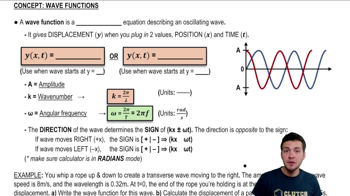
Intro to Wave Functions

Quantum Mechanics and Probability Density

In quantum mechanics, the probability density describes the likelihood of finding a particle, such as an electron, in a particular region of space. It is derived from the square of the wave function's amplitude. For this problem, calculating the distance at which the probability density of the electron drops to 10% of its surface value involves understanding how quantum states decay in potential wells.
추천 영상:
가이드 코스
8:13
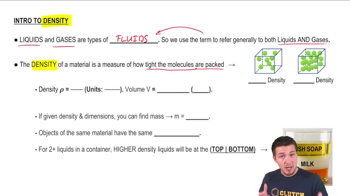
Intro to Density

Exponential Decay in Quantum Tunneling

Exponential decay is a key concept in quantum mechanics, particularly in the context of tunneling phenomena. When an electron is near a potential barrier, its probability density decreases exponentially with distance from the barrier. This behavior is essential for determining how far from the surface the electron's probability density reaches a specific fraction of its initial value, such as 10% in this scenario.
추천 영상:
가이드 코스
04:24
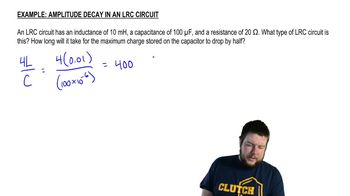
Amplitude Decay in an LRC Circuit
관련 실천
교과서 질문

In most metals, the atomic ions form a regular arrangement called a crystal lattice. The conduction electrons in the sea of electrons move through this lattice. FIGURE P40.34 is a one-dimensional model of a crystal lattice. The ions have mass m, charge e, and an equilibrium separation b. Suppose this crystal consists of aluminum ions with an equilibrium spacing of 0.30 nm. What are the energies of the four lowest vibrational states of these ions?

50
views
교과서 질문

In most metals, the atomic ions form a regular arrangement called a crystal lattice. The conduction electrons in the sea of electrons move through this lattice. FIGURE P40.34 is a one-dimensional model of a crystal lattice. The ions have mass m, charge e, and an equilibrium separation b. What wavelength photons are emitted during quantum jumps between adjacent energy levels? Is this wavelength in the infrared, visible, or ultraviolet portion of the spectrum?

1624
views
1
rank
교과서 질문

CALC A particle of mass m has the wave function ψ(x) = Ax exp (−x²/a²) when it is in an allowed energy level with E = 0. Draw a graph of ψ(x) versus x.

68
views
교과서 질문

CALC A particle of mass m has the wave function ψ(x) = Ax exp (−x²/a²) when it is in an allowed energy level with E = 0. At what value or values of x is the particle most likely to be found?

58
views
교과서 질문

For a particle in a finite potential well of width L and depth U0, what is the ratio of the probability Prob(in δx at x=L+η) to the probability Prob(in δx at x = L)?

1646
views
교과서 질문

CALC Determine the normalization constant A1 for the n = 1 ground-state wave function of the quantum harmonic oscillator. Your answer will be in terms of b.

94
views