
Ch 40: One-Dimensional Quantum Mechanics
Knight Calc - Physics for Scientists and Engineers 5th Edition
Knight Calc5th EditionPhysics for Scientists and EngineersISBN: 9780137344796당신이 사용하는 게 아니라요?교과서 변경
40장, 문제 34c

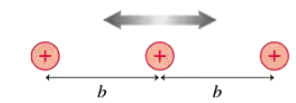
In most metals, the atomic ions form a regular arrangement called a crystal lattice. The conduction electrons in the sea of electrons move through this lattice. FIGURE P40.34 is a one-dimensional model of a crystal lattice. The ions have mass m, charge e, and an equilibrium separation b. What wavelength photons are emitted during quantum jumps between adjacent energy levels? Is this wavelength in the infrared, visible, or ultraviolet portion of the spectrum?

검증된 단계별 안내
1
Step 1: Begin by understanding the physical system described in the problem. The ions in the crystal lattice are modeled as a one-dimensional harmonic oscillator. The energy levels of a quantum harmonic oscillator are quantized and given by the formula: \( E_n = \left(n + \frac{1}{2}\right) \hbar \omega \), where \( n \) is the quantum number, \( \hbar \) is the reduced Planck's constant, and \( \omega \) is the angular frequency of the oscillator.
Step 2: Determine the angular frequency \( \omega \) of the harmonic oscillator. The angular frequency is related to the mass \( m \) of the ions and the effective spring constant \( k \) of the lattice by the formula: \( \omega = \sqrt{\frac{k}{m}} \). The spring constant \( k \) can be derived from the electrostatic forces between the ions, which depend on their charge \( e \) and equilibrium separation \( b \).
Step 3: Calculate the energy difference between adjacent energy levels. For a quantum harmonic oscillator, the energy difference between adjacent levels is constant and given by \( \Delta E = \hbar \omega \). This energy difference corresponds to the energy of the photon emitted during a quantum jump between adjacent levels.
Step 4: Relate the energy of the photon \( \Delta E \) to its wavelength \( \lambda \) using the photon energy formula: \( \Delta E = \frac{hc}{\lambda} \), where \( h \) is Planck's constant and \( c \) is the speed of light. Rearrange this formula to solve for the wavelength: \( \lambda = \frac{hc}{\Delta E} \). Substitute \( \Delta E = \hbar \omega \) into this equation.
Step 5: Analyze the wavelength \( \lambda \) obtained to determine its position in the electromagnetic spectrum. Compare the calculated wavelength to the ranges for infrared (700 nm to 1 mm), visible light (400 nm to 700 nm), and ultraviolet (10 nm to 400 nm) to classify the photon emission.

비슷한 문제에 대한 검증된 영상 답변:

이 영상 해법은 위 문제에 도움이 된다고 튜터들이 추천한 것입니다.
영상 길이:
13m
도움이 되었나요?

주요 개념

질문에 올바르게 답하기 위해 반드시 이해해야 하는 핵심 개념들은 다음과 같습니다.

Crystal Lattice Structure

A crystal lattice is a highly ordered structure formed by the arrangement of atoms or ions in a solid. In metals, this arrangement allows for the conduction electrons to move freely, creating a 'sea of electrons' that facilitates electrical conductivity. The regular spacing of ions in the lattice influences the material's properties, including its ability to absorb and emit photons during electronic transitions.
추천 영상:
가이드 코스
05:37
Electric Charge

Quantum Jumps and Energy Levels

Quantum jumps refer to the transitions of electrons between discrete energy levels within an atom or ion. When an electron absorbs energy, it can move to a higher energy level, and when it loses energy, it returns to a lower level, emitting a photon in the process. The energy of the emitted photon corresponds to the difference in energy between the two levels, which determines its wavelength and position in the electromagnetic spectrum.
추천 영상:
가이드 코스
14:28
Jumping into a moving disc

Electromagnetic Spectrum

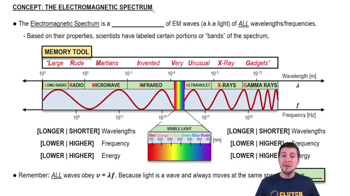
The electromagnetic spectrum encompasses all types of electromagnetic radiation, ranging from radio waves to gamma rays. Visible light, infrared, and ultraviolet are specific regions within this spectrum, defined by their wavelengths. The wavelength of emitted photons during quantum jumps can be calculated using the energy difference between levels, allowing us to determine whether the emitted light falls within the infrared, visible, or ultraviolet range.
추천 영상:
가이드 코스
06:06
The Electromagnetic Spectrum
관련 실천
교과서 질문

A typical electron in a piece of metallic sodium has energy −E₀ compared to a free electron, where E₀ is the 2.36 eV work function of sodium. At what distance beyond the surface of the metal is the electron’s probability density 10% of its value at the surface?

56
views
교과서 질문

In most metals, the atomic ions form a regular arrangement called a crystal lattice. The conduction electrons in the sea of electrons move through this lattice. FIGURE P40.34 is a one-dimensional model of a crystal lattice. The ions have mass m, charge e, and an equilibrium separation b. Suppose this crystal consists of aluminum ions with an equilibrium spacing of 0.30 nm. What are the energies of the four lowest vibrational states of these ions?

50
views
교과서 질문

For a particle in a finite potential well of width L and depth U0, what is the ratio of the probability Prob(in δx at x=L+η) to the probability Prob(in δx at x = L)?

1646
views
교과서 질문

A particle confined in a rigid one-dimensional box of length 10 fm has an energy level En = 32.9 MeV and an adjacent energy level En+1 = 51.4 MeV. What is the mass of the particle? Can you identify it?

88
views
교과서 질문

CALC Consider a particle in a rigid box of length L. For each of the states n = 1,n = 2, and n = 3: Where, in terms of L, are the positions at which the particle is most likely to be found?

52
views
교과서 질문

CALC Determine the normalization constant A1 for the n = 1 ground-state wave function of the quantum harmonic oscillator. Your answer will be in terms of b.

94
views