
Ch 40: One-Dimensional Quantum Mechanics
Knight Calc - Physics for Scientists and Engineers 5th Edition
Knight Calc5th EditionPhysics for Scientists and EngineersISBN: 9780137344796당신이 사용하는 게 아니라요?교과서 변경
40장, 문제 48a

What is the probability that an electron will tunnel through a 0.50 nm air gap from a metal to a STM probe if the work function is 4.0 eV?

검증된 단계별 안내
1
Step 1: Understand the concept of quantum tunneling. Quantum tunneling is a phenomenon where particles like electrons can pass through a potential barrier even if their energy is less than the height of the barrier. The probability of tunneling depends on the width of the barrier, the energy of the particle, and the height of the potential barrier (work function in this case).
Step 2: Use the formula for tunneling probability. The probability of tunneling (P) can be approximated using the equation: P = e - k , where k is the decay constant. The decay constant is given by: k = 2 m ħ ² ( U - E ) , where m is the mass of the electron, ħ is the reduced Planck's constant, U is the potential barrier (work function), and E is the energy of the electron.
Step 3: Substitute the given values into the decay constant formula. The width of the barrier is 0.50 nm (convert to meters: 0.50 × 10 -9 m), the work function U is 4.0 eV (convert to joules: 4.0 × 1.6 -19 J), and the mass of the electron is 9.11 × 10 -31 kg. Use these values to calculate k .
Step 4: Calculate the tunneling probability using the formula P = e - k × d , where d is the width of the barrier (0.50 nm). Substitute the calculated value of k and d into the equation.
Step 5: Interpret the result. The tunneling probability will be a very small number, indicating that the likelihood of the electron tunneling through the air gap is extremely low. This aligns with the quantum mechanical nature of tunneling, which becomes significant only for very small barriers or specific conditions.

비슷한 문제에 대한 검증된 영상 답변:

이 영상 해법은 위 문제에 도움이 된다고 튜터들이 추천한 것입니다.
도움이 되었나요?

주요 개념

질문에 올바르게 답하기 위해 반드시 이해해야 하는 핵심 개념들은 다음과 같습니다.

Quantum Tunneling

Quantum tunneling is a quantum mechanical phenomenon where a particle can pass through a potential energy barrier, even if it does not have enough energy to overcome that barrier classically. This occurs due to the wave-like nature of particles at the quantum level, allowing for a non-zero probability of finding the particle on the other side of the barrier.

Work Function

The work function is the minimum energy required to remove an electron from the surface of a material. It is a critical parameter in understanding electron emission processes, such as photoemission and thermionic emission, and plays a significant role in determining the likelihood of tunneling events in quantum mechanics.
추천 영상:
08:30
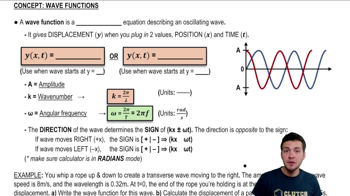
Intro to Wave Functions

Potential Barrier

A potential barrier is a region in space where the potential energy of a particle is higher than its total energy, effectively preventing the particle from passing through it under classical physics. In quantum mechanics, however, particles can tunnel through these barriers, and the height and width of the barrier, along with the particle's energy, influence the tunneling probability.
추천 영상:
07:33
Electric Potential