
Ch 40: One-Dimensional Quantum Mechanics
Knight Calc - Physics for Scientists and Engineers 5th Edition
Knight Calc5th EditionPhysics for Scientists and EngineersISBN: 9780137344796당신이 사용하는 게 아니라요?교과서 변경
40장, 문제 42c

CALC A particle of mass m has the wave function ψ(x) = Ax exp (−x²/a²) when it is in an allowed energy level with E = 0. Find and graph the potential-energy function U(x).

검증된 단계별 안내
1
Step 1: Recall the relationship between the potential energy function U(x), the wave function ψ(x), and the total energy E in the Schrödinger equation. The time-independent Schrödinger equation is given by: −(ℏ²/2m)(d²ψ/dx²) + U(x)ψ = Eψ. Here, E is the total energy, which is given as 0 in this problem.
Step 2: Substitute the given wave function ψ(x) = A exp(−x²/a²) into the Schrödinger equation. First, compute the first and second derivatives of ψ(x) with respect to x. The first derivative is: dψ/dx = −(2x/a²)A exp(−x²/a²). The second derivative is: d²ψ/dx² = A exp(−x²/a²) [(4x²/a⁴) − (2/a²)].
Step 3: Substitute d²ψ/dx² and ψ(x) into the Schrödinger equation. Since E = 0, the equation simplifies to: −(ℏ²/2m)(d²ψ/dx²) + U(x)ψ = 0. Rearrange to solve for U(x): U(x) = (ℏ²/2m)(1/ψ)(d²ψ/dx²).
Step 4: Substitute the expressions for ψ(x) and d²ψ/dx² into the formula for U(x). After simplification, you will find that the potential energy function is: U(x) = (ℏ²/2m)[(4x²/a⁴) − (2/a²)]. This represents a harmonic oscillator-like potential with an additional constant term.
Step 5: To graph U(x), note that it is a parabolic function of x with a minimum at x = 0. The term (4x²/a⁴) dominates for large |x|, causing U(x) to increase quadratically. Plot U(x) as a function of x, showing a parabola centered at x = 0 with its shape determined by the constants , m, and a.

비슷한 문제에 대한 검증된 영상 답변:

이 영상 해법은 위 문제에 도움이 된다고 튜터들이 추천한 것입니다.
영상 길이:
10m
도움이 되었나요?

주요 개념

질문에 올바르게 답하기 위해 반드시 이해해야 하는 핵심 개념들은 다음과 같습니다.

Wave Function

The wave function, denoted as ψ(x), describes the quantum state of a particle in quantum mechanics. It contains all the information about the system, including the probability distribution of a particle's position. In this case, the given wave function indicates how the particle's position is distributed in space, which is crucial for determining its energy and potential energy.
추천 영상:
가이드 코스
08:30
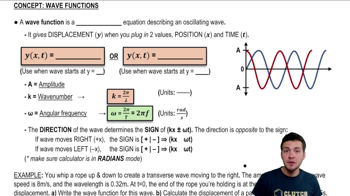
Intro to Wave Functions

Potential Energy Function

The potential energy function U(x) represents the potential energy of a particle as a function of its position x. In quantum mechanics, it is often derived from the wave function and the total energy of the system. For a particle in a bound state, the potential energy can be inferred from the behavior of the wave function, particularly its shape and the energy level it corresponds to.
추천 영상:
가이드 코스
07:24
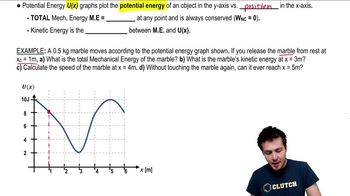
Potential Energy Graphs

Energy Levels in Quantum Mechanics

Energy levels in quantum mechanics refer to the discrete values of energy that a quantum system can have. For a particle in a potential well, these levels are quantized, meaning the particle can only occupy specific energy states. The problem states that the energy E=0, indicating that the particle is in a specific state that can help determine the form of the potential energy function U(x) based on the wave function provided.
추천 영상:
가이드 코스
06:24
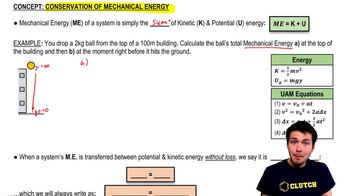
Conservation Of Mechanical Energy
관련 실천
교과서 질문

In a nuclear physics experiment, a proton is fired toward a Z = 13 nucleus with the diameter and neutron energy levels shown in Figure 40.17. The nucleus, which was initially in its ground state, subsequently emits a gamma ray with wavelength 1.73×10⁻⁴ nm. What was the minimum initial speed of the proton? Hint: Don't neglect the proton-nucleus collision.

720
views
교과서 질문

CALC A particle of mass m has the wave function ψ(x) = Ax exp (−x²/a²) when it is in an allowed energy level with E = 0. Draw a graph of ψ(x) versus x.

68
views
교과서 질문

CALC A particle of mass m has the wave function ψ(x) = Ax exp (−x²/a²) when it is in an allowed energy level with E = 0. At what value or values of x is the particle most likely to be found?

58
views
교과서 질문

Figure 40.17 showed that a typical nuclear radius is 4.0 fm. As you’ll learn in Chapter 42, a typical energy of a neutron bound inside the nuclear potential well is En = −20 MeV. To find out how “fuzzy” the edge of the nucleus is, what is the neutron’s penetration distance into the classically forbidden region as a fraction of the nuclear radius?

56
views
교과서 질문

CALC Determine the normalization constant A1 for the n = 1 ground-state wave function of the quantum harmonic oscillator. Your answer will be in terms of b.

94
views
교과서 질문

A proton’s energy is 1.0 MeV below the top of a 10-fm-wide energy barrier. What is the probability that the proton will tunnel through the barrier?

52
views