Ch 09: Rotation of Rigid Bodies
Young & Freedman Calc - University Physics 14th Edition
Young & Freedman Calc14th EditionUniversity PhysicsISBN: 9780321973610당신이 사용하는 게 아니라요?교과서 변경
9장, 문제 46

A uniform 2.00-m ladder of mass 9.00 kg is leaning against a vertical wall while making an angle of 53.0° with the floor. A worker pushes the ladder up against the wall until it is vertical. What is the increase in the gravitational potential energy of the ladder?

검증된 단계별 안내
1
Step 1: Understand the problem. The gravitational potential energy (U) of an object is given by the formula: U = mgh, where m is the mass of the object, g is the acceleration due to gravity, and h is the height of the center of mass above a reference point. The goal is to calculate the change in gravitational potential energy as the ladder moves from its initial inclined position to a vertical position.
Step 2: Determine the initial height of the ladder's center of mass. Since the ladder is uniform, its center of mass is located at its midpoint. Initially, the ladder makes an angle of 53.0° with the floor. The height of the center of mass can be calculated as: hinitial = (L/2)sin(θ), where L is the length of the ladder and θ is the angle with the floor.
Step 3: Determine the final height of the ladder's center of mass. When the ladder is vertical, its center of mass is directly above the floor at a height of: hfinal = L/2, since the center of mass is still at the midpoint of the ladder.
Step 4: Calculate the change in gravitational potential energy. The change in gravitational potential energy is given by: ΔU = mg(hfinal - hinitial). Substitute the expressions for hfinal and hinitial into this equation.
Step 5: Plug in the known values. Use m = 9.00 kg, g = 9.8 m/s², L = 2.00 m, and θ = 53.0°. Perform the calculations to find the change in gravitational potential energy.

비슷한 문제에 대한 검증된 영상 답변:

이 영상 해법은 위 문제에 도움이 된다고 튜터들이 추천한 것입니다.
영상 길이:
5m
도움이 되었나요?

주요 개념

질문에 올바르게 답하기 위해 반드시 이해해야 하는 핵심 개념들은 다음과 같습니다.

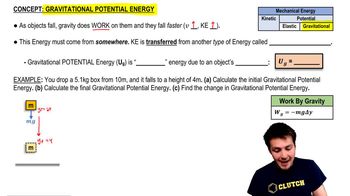
Gravitational Potential Energy

Gravitational potential energy (GPE) is the energy an object possesses due to its position in a gravitational field. It is calculated using the formula GPE = mgh, where m is the mass, g is the acceleration due to gravity, and h is the height above a reference point. In this scenario, as the ladder is raised, its height increases, leading to an increase in GPE.
추천 영상:
가이드 코스
06:35
Gravitational Potential Energy

Height Calculation

To determine the change in gravitational potential energy, it is essential to calculate the height of the ladder's center of mass at both the initial and final positions. When the ladder is leaning at an angle, the height can be found using trigonometric functions, specifically h = L * sin(θ), where L is the length of the ladder and θ is the angle with the horizontal. This height change is crucial for calculating the increase in GPE.
추천 영상:
가이드 코스
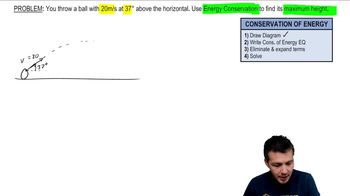
05:01
Calculating Max Height with Energy Conservation

Work-Energy Principle

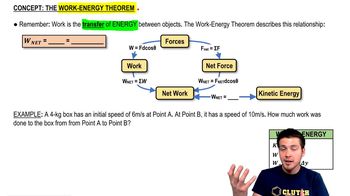
The work-energy principle states that the work done on an object is equal to the change in its energy. In this context, as the worker pushes the ladder up, work is done against gravity, resulting in an increase in the ladder's gravitational potential energy. Understanding this principle helps in analyzing the energy transformations occurring during the ladder's movement.
추천 영상:
가이드 코스
04:10
The Work-Energy Theorem
관련 실천
교과서 질문

If we multiply all the design dimensions of an object by a scaling factor f, its volume and mass will be multiplied by f3. By what factor will its moment of inertia be multiplied?

1762
views

교과서 질문

A uniform sphere with mass 28.028.0 kg and radius 0.3800.380 m is rotating at constant angular velocity about a stationary axis that lies along a diameter of the sphere. If the kinetic energy of the sphere is 236236 J, what is the tangential velocity of a point on the rim of the sphere?

2888
views
교과서 질문

A wheel is turning about an axis through its center with constant angular acceleration. Starting from rest, at t = 0, the wheel turns through 8.20 revolutions in 12.0 s. At t = 12.0 s the kinetic energy of the wheel is 36.0 J. For an axis through its center, what is the moment of inertia of the wheel?

2712
views
교과서 질문

Find the moment of inertia of a hoop (a thin-walled, hollow ring) with mass M and radius R about an axis perpendicular to the hoop's plane at an edge.

3101
views
교과서 질문

The flywheel of a gasoline engine is required to give up 500 J of kinetic energy while its angular velocity decreases from 650 rev/min to 520 rev/min. What moment of inertia is required?

3124
views
교과서 질문

If we multiply all the design dimensions of an object by a scaling factor f, its volume and mass will be multiplied by f3. If a 1/48 scale model has a rotational kinetic energy of 2.5 J, what will be the kinetic energy for the full-scale object of the same material rotating at the same angular velocity?

1803
views