
Ch 09: Rotation of Rigid Bodies
Young & Freedman Calc - University Physics 14th Edition
Young & Freedman Calc14th EditionUniversity PhysicsISBN: 9780321973610당신이 사용하는 게 아니라요?교과서 변경
9장, 문제 47b

If we multiply all the design dimensions of an object by a scaling factor f, its volume and mass will be multiplied by f3. If a 1/48 scale model has a rotational kinetic energy of 2.5 J, what will be the kinetic energy for the full-scale object of the same material rotating at the same angular velocity?

검증된 단계별 안내
1
Step 1: Understand the scaling relationship. When the dimensions of an object are scaled by a factor f, its volume increases by f^3. Since the object is made of the same material, its mass will also scale by f^3 because mass is proportional to volume for a uniform material.
Step 2: Recall the formula for rotational kinetic energy: \( KE_{rot} = \frac{1}{2} I \omega^2 \), where \( I \) is the moment of inertia and \( \omega \) is the angular velocity. The angular velocity \( \omega \) remains the same for both the model and the full-scale object.
Step 3: The moment of inertia \( I \) depends on the mass and the square of the dimensions of the object. Since the mass scales by \( f^3 \) and the dimensions scale by \( f \), the moment of inertia \( I \) will scale by \( f^5 \) (\( f^3 \) from mass and \( f^2 \) from the square of the dimensions).
Step 4: Relate the rotational kinetic energy of the full-scale object to the scaled moment of inertia. Since \( KE_{rot} \) is proportional to \( I \), the rotational kinetic energy of the full-scale object will be scaled by \( f^5 \) compared to the model.
Step 5: Substitute the scaling factor \( f = 48 \) into the scaling relationship for kinetic energy. Multiply the rotational kinetic energy of the model (2.5 J) by \( 48^5 \) to determine the kinetic energy of the full-scale object.

비슷한 문제에 대한 검증된 영상 답변:

이 영상 해법은 위 문제에 도움이 된다고 튜터들이 추천한 것입니다.
영상 길이:
9m
도움이 되었나요?

주요 개념

질문에 올바르게 답하기 위해 반드시 이해해야 하는 핵심 개념들은 다음과 같습니다.

Scaling Laws

Scaling laws describe how physical properties of an object change when its dimensions are scaled by a factor. For example, if all linear dimensions of an object are multiplied by a factor 'f', its volume scales by 'f^3' and surface area by 'f^2'. This principle is crucial for understanding how properties like mass and energy relate to size in physical systems.
추천 영상:
가이드 코스
04:54
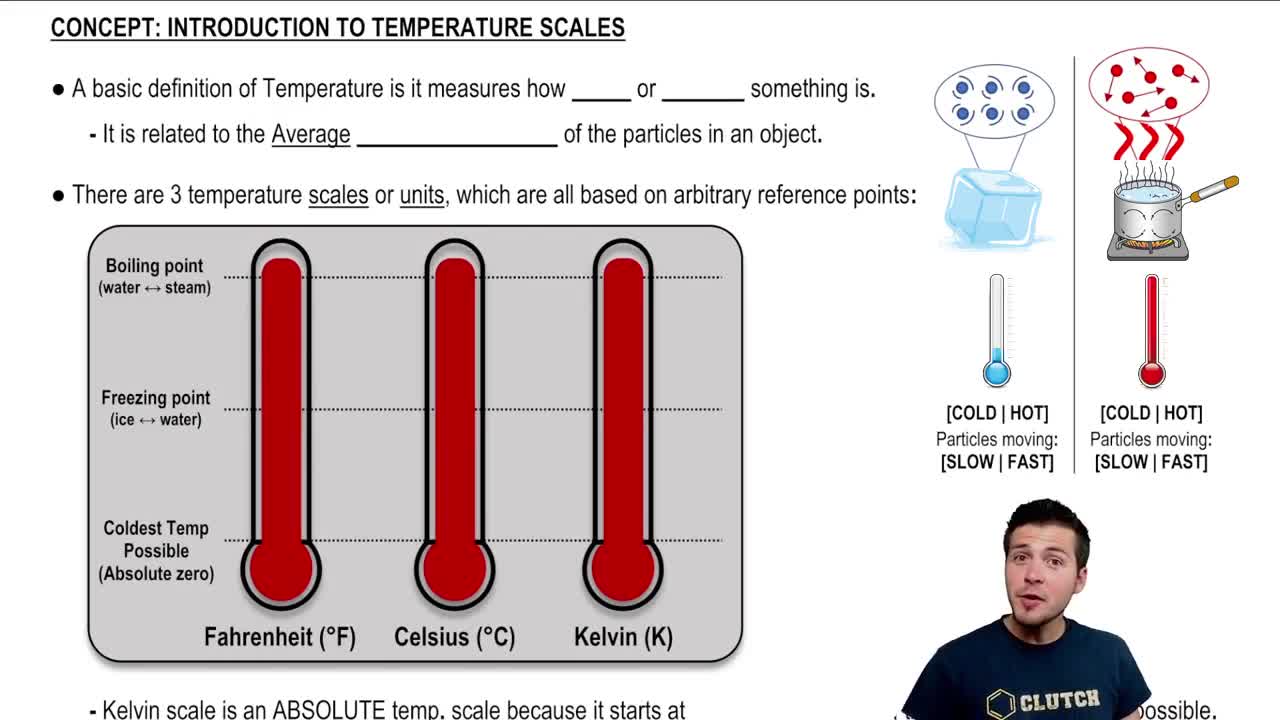
Introduction To Temperature Scales

Rotational Kinetic Energy

Rotational kinetic energy is the energy an object possesses due to its rotation, calculated using the formula KE = 1/2 I ω^2, where 'I' is the moment of inertia and 'ω' is the angular velocity. When comparing models of different sizes, the moment of inertia changes with the square of the scaling factor, which affects the kinetic energy of the object.
추천 영상:
가이드 코스
06:07
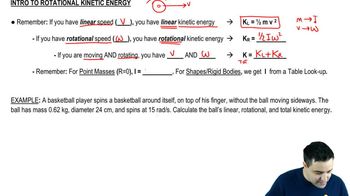
Intro to Rotational Kinetic Energy

Moment of Inertia

The moment of inertia is a measure of an object's resistance to changes in its rotational motion, depending on the mass distribution relative to the axis of rotation. For scaled objects, the moment of inertia increases with the square of the scaling factor, which is essential for calculating how kinetic energy scales when comparing a model to its full-size counterpart.
추천 영상:
가이드 코스
11:47
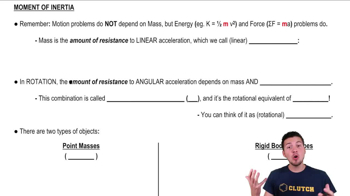
Intro to Moment of Inertia