
Ch 09: Rotation of Rigid Bodies
Young & Freedman Calc - University Physics 14th Edition
Young & Freedman Calc14th EditionUniversity PhysicsISBN: 9780321973610당신이 사용하는 게 아니라요?교과서 변경
9장, 문제 48

Find the moment of inertia of a hoop (a thin-walled, hollow ring) with mass M and radius R about an axis perpendicular to the hoop's plane at an edge.

검증된 단계별 안내
1
Step 1: Recall the formula for the moment of inertia of a hoop about an axis perpendicular to its plane and passing through its center. For a hoop of mass \( M \) and radius \( R \), the moment of inertia is \( I = M R^2 \). However, in this problem, the axis is at the edge of the hoop, not the center.
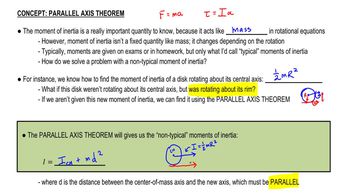
Step 2: Use the parallel axis theorem to account for the shift in the axis. The parallel axis theorem states \( I = I_{\text{center}} + M d^2 \), where \( I_{\text{center}} \) is the moment of inertia about the center, \( M \) is the mass, and \( d \) is the distance between the center and the new axis.
Step 3: Determine the distance \( d \) between the center of the hoop and the edge. Since the hoop has a radius \( R \), the distance \( d \) is equal to \( R \).
Step 4: Substitute \( I_{\text{center}} = M R^2 \) and \( d = R \) into the parallel axis theorem formula. This gives \( I = M R^2 + M R^2 \).
Step 5: Combine the terms to express the total moment of inertia. The result is \( I = 2 M R^2 \). This is the moment of inertia of the hoop about the specified axis.

비슷한 문제에 대한 검증된 영상 답변:

이 영상 해법은 위 문제에 도움이 된다고 튜터들이 추천한 것입니다.
영상 길이:
2m

주요 개념

질문에 올바르게 답하기 위해 반드시 이해해야 하는 핵심 개념들은 다음과 같습니다.

Moment of Inertia

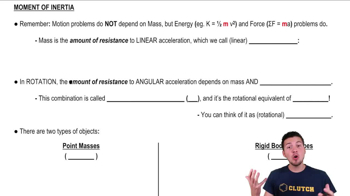
Moment of inertia is a measure of an object's resistance to changes in its rotational motion about a specific axis. It depends on the mass distribution relative to that axis. For a hoop, the moment of inertia can be calculated using the formula I = Σ(m * r²), where m is the mass of each particle and r is the distance from the axis of rotation.
추천 영상:
가이드 코스
11:47
Intro to Moment of Inertia

Parallel Axis Theorem

The parallel axis theorem allows us to calculate the moment of inertia of an object about any axis parallel to an axis through its center of mass. It states that I = I_cm + Md², where I_cm is the moment of inertia about the center of mass, M is the total mass, and d is the distance between the two axes. This theorem is essential for finding the moment of inertia of the hoop about an edge.
추천 영상:
가이드 코스
13:46
Parallel Axis Theorem

Geometry of the Hoop

A hoop is defined as a thin-walled, hollow ring with all its mass concentrated at a constant distance (the radius R) from the axis of rotation. Understanding the geometry of the hoop is crucial for applying the moment of inertia formulas correctly, as it directly influences the calculations and the distribution of mass relative to the chosen axis.
추천 영상:
가이드 코스
02:01
Flux Through Angled Surface
관련 실천
교과서 질문

A thin, rectangular sheet of metal has mass M and sides of length a and b. Use the parallel-axis theorem to calculate the moment of inertia of the sheet for an axis that is perpendicular to the plane of the sheet and that passes through one corner of the sheet.

3345
views
교과서 질문

A thin uniform rod of mass M and length L is bent at its center so that the two segments are now perpendicular to each other. Find its moment of inertia about an axis perpendicular to its plane and passing through the point where the two segments meet.

2706
views
교과서 질문

If we multiply all the design dimensions of an object by a scaling factor f, its volume and mass will be multiplied by f3. By what factor will its moment of inertia be multiplied?

1762
views
교과서 질문

A uniform 2.00-m ladder of mass 9.00 kg is leaning against a vertical wall while making an angle of 53.0° with the floor. A worker pushes the ladder up against the wall until it is vertical. What is the increase in the gravitational potential energy of the ladder?

1645
views
교과서 질문

A slender rod with length L has a mass per unit length that varies with distance from the left end, where x = 0, according to dm/dx = γx, where γ has units of kg/m2. Use Eq. (9.20) to calculate the moment of inertia of the rod for an axis at the left end, perpendicular to the rod. Use the expression you derived in part (a) to express I in terms of M and L. How does your result compare to that for a uniform rod? Explain.

3073
views
교과서 질문

If we multiply all the design dimensions of an object by a scaling factor f, its volume and mass will be multiplied by f3. If a 1/48 scale model has a rotational kinetic energy of 2.5 J, what will be the kinetic energy for the full-scale object of the same material rotating at the same angular velocity?

1803
views