
Ch 12: Fluid Mechanics
Young & Freedman Calc - University Physics 14th Edition
Young & Freedman Calc14th EditionUniversity PhysicsISBN: 9780321973610당신이 사용하는 게 아니라요?교과서 변경
12장, 문제 48bc

A soft drink (mostly water) flows in a pipe at a beverage plant with a mass flow rate that would fill 220 0.355-L cans per minute. At point 2 in the pipe, the gauge pressure is 152 kPa and the cross-sectional area is 8.00 cm2. At point 1, 1.35 m above point 2, the cross-sectional area is 2.00 cm2. Find the (b) volume flow rate. (c) flow speeds at points 1 and 2.

검증된 단계별 안내
1
To find the volume flow rate, first calculate the total volume of soft drink flowing per minute. Since 220 cans are filled per minute and each can has a volume of 0.355 L, multiply these values to get the total volume per minute: \( V = 220 \times 0.355 \text{ L} \).
Convert the volume flow rate from liters per minute to cubic meters per second. Use the conversion factor \( 1 \text{ L} = 0.001 \text{ m}^3 \) and \( 1 \text{ min} = 60 \text{ s} \).
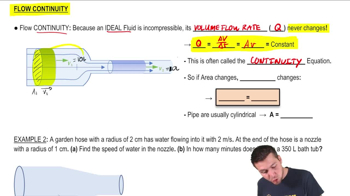
To find the flow speeds at points 1 and 2, use the continuity equation, which states that the volume flow rate \( Q \) is constant throughout the pipe: \( Q = A_1 v_1 = A_2 v_2 \). Here, \( A_1 \) and \( A_2 \) are the cross-sectional areas at points 1 and 2, respectively, and \( v_1 \) and \( v_2 \) are the flow speeds.
Calculate the flow speed at point 2 using the formula \( v_2 = \frac{Q}{A_2} \), where \( A_2 = 8.00 \text{ cm}^2 \). Convert \( A_2 \) to square meters by using the conversion factor \( 1 \text{ cm}^2 = 0.0001 \text{ m}^2 \).
Calculate the flow speed at point 1 using the formula \( v_1 = \frac{Q}{A_1} \), where \( A_1 = 2.00 \text{ cm}^2 \). Again, convert \( A_1 \) to square meters using the same conversion factor.

비슷한 문제에 대한 검증된 영상 답변:

이 영상 해법은 위 문제에 도움이 된다고 튜터들이 추천한 것입니다.
영상 길이:
8m
도움이 되었나요?

주요 개념

질문에 올바르게 답하기 위해 반드시 이해해야 하는 핵심 개념들은 다음과 같습니다.

Continuity Equation

The continuity equation in fluid dynamics states that the mass flow rate must remain constant from one cross-section of a pipe to another, assuming incompressible flow. It is expressed as A1V1 = A2V2, where A is the cross-sectional area and V is the flow speed. This principle helps determine the flow speeds at different points in the pipe.
추천 영상:
가이드 코스
11:08
Flow Continuity

Bernoulli's Principle

Bernoulli's principle relates the pressure, velocity, and height in a flowing fluid, stating that an increase in the speed of the fluid occurs simultaneously with a decrease in pressure or potential energy. It is crucial for understanding how pressure and velocity change between two points in the pipe, especially when elevation changes are involved.
추천 영상:
가이드 코스
14:47
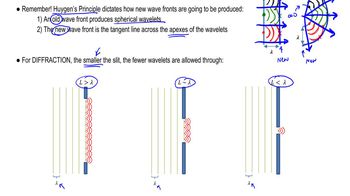
Diffraction with Huygen's Principle

Volume Flow Rate

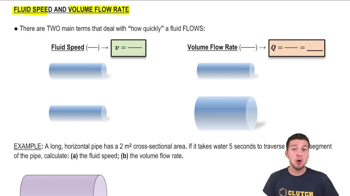
Volume flow rate is the volume of fluid that passes through a given surface per unit time, typically measured in cubic meters per second (m³/s). It can be calculated using the mass flow rate and the density of the fluid, or directly from the product of cross-sectional area and flow speed. This concept is essential for determining how much fluid is moving through the pipe.
추천 영상:
가이드 코스
6:34
Fluid Speed & Volume Flow Rate