
Ch 12: Fluid Mechanics
Young & Freedman Calc - University Physics 14th Edition
Young & Freedman Calc14th EditionUniversity PhysicsISBN: 9780321973610당신이 사용하는 게 아니라요?교과서 변경
12장, 문제 46

At one point in a pipeline the water's speed is 3.00 m/s and the gauge pressure is 5.00×10⁴ Pa. Find the gauge pressure at a second point in the line, 11.0 m lower than the first, if the pipe diameter at the second point is twice that at the first.

검증된 단계별 안내
1
Identify the known variables: initial speed \( v_1 = 3.00 \text{ m/s} \), initial gauge pressure \( P_1 = 5.00 \times 10^4 \text{ Pa} \), height difference \( h = 11.0 \text{ m} \), and the relationship between the diameters of the pipe at the two points.
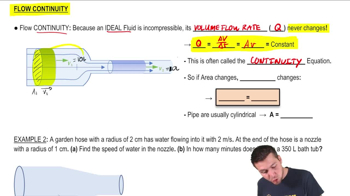
Apply the principle of conservation of mass, which states that the mass flow rate must be constant. This can be expressed as \( A_1 v_1 = A_2 v_2 \), where \( A \) is the cross-sectional area of the pipe. Since the diameter at the second point is twice that at the first, \( A_2 = 4A_1 \). Solve for \( v_2 \) to find the speed at the second point.
Use Bernoulli's equation to relate the pressures and velocities at the two points: \( P_1 + \frac{1}{2} \rho v_1^2 + \rho gh_1 = P_2 + \frac{1}{2} \rho v_2^2 + \rho gh_2 \). Here, \( \rho \) is the density of water, and \( g \) is the acceleration due to gravity. Substitute \( h_1 = 0 \) and \( h_2 = -11.0 \text{ m} \) to account for the height difference.
Rearrange Bernoulli's equation to solve for the gauge pressure at the second point \( P_2 \): \( P_2 = P_1 + \frac{1}{2} \rho (v_1^2 - v_2^2) + \rho g h \).
Substitute the known values into the equation to calculate \( P_2 \). Remember to use the density of water \( \rho = 1000 \text{ kg/m}^3 \) and the acceleration due to gravity \( g = 9.81 \text{ m/s}^2 \).

비슷한 문제에 대한 검증된 영상 답변:

이 영상 해법은 위 문제에 도움이 된다고 튜터들이 추천한 것입니다.
영상 길이:
7m
도움이 되었나요?

주요 개념

질문에 올바르게 답하기 위해 반드시 이해해야 하는 핵심 개념들은 다음과 같습니다.

Bernoulli's Equation

Bernoulli's Equation relates the speed, pressure, and height of a fluid in steady flow. It states that the sum of the pressure energy, kinetic energy per unit volume, and potential energy per unit volume is constant along a streamline. This principle helps determine how changes in speed and height affect pressure in a fluid system.
추천 영상:
가이드 코스
08:25
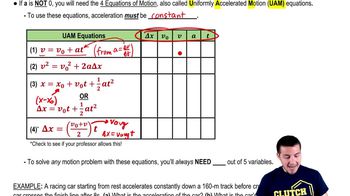
Kinematics Equations

Continuity Equation

The Continuity Equation is a principle of fluid dynamics that states the mass flow rate must remain constant from one cross-section of a pipe to another. It is expressed as A1V1 = A2V2, where A is the cross-sectional area and V is the fluid velocity. This concept is crucial for understanding how changes in pipe diameter affect fluid speed.
추천 영상:
가이드 코스
11:08
Flow Continuity

Hydrostatic Pressure

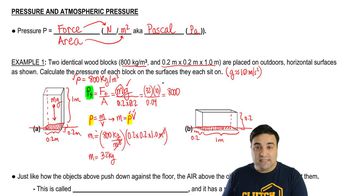
Hydrostatic Pressure is the pressure exerted by a fluid at equilibrium due to the force of gravity. It increases with depth in a fluid and is given by the equation P = ρgh, where ρ is the fluid density, g is the acceleration due to gravity, and h is the height difference. This concept is essential for calculating pressure changes due to elevation differences in a fluid system.
추천 영상:
가이드 코스
17:04
Pressure and Atmospheric Pressure
관련 실천
교과서 질문

A small circular hole 6.00 mm in diameter is cut in the side of a large water tank, 14.0 m below the water level in the tank. The top of the tank is open to the air. Find (a) the speed of efflux of the water and (b) the volume discharged per second.

2685
views
교과서 질문

Home Repair. You need to extend a 2.50-inch-diameter pipe, but you have only a 1.00-inch-diameter pipe on hand. You make a fitting to connect these pipes end to end. If the water is flowing at 6.00 cm/s in the wide pipe, how fast will it be flowing through the narrow one?

1658
views
교과서 질문

A soft drink (mostly water) flows in a pipe at a beverage plant with a mass flow rate that would fill 220 0.355-L cans per minute. At point 2 in the pipe, the gauge pressure is 152 kPa and the cross-sectional area is 8.00 cm2. At point 1, 1.35 m above point 2, the cross-sectional area is 2.00 cm2. Find the (b) volume flow rate. (c) flow speeds at points 1 and 2.

2496
views
교과서 질문

A pressure difference of 6.00 × 10⁴ Pa is required to maintain a volume flow rate of 0.800m3/s for a viscous fluid flowing through a section of cylindrical pipe that has radius 0.210 m. What pressure difference is required to maintain the same volume flow rate if the radius of the pipe is decreased to 0.0700 m?

2085
views
교과서 질문

BIO. Artery Blockage. A medical technician is trying to determine what percentage of a patient's artery is blocked by plaque. To do this, she measures the blood pressure just before the region of blockage and finds that it is 1.20×10⁴ Pa, while in the region of blockage it is 1.15×10⁴ Pa. Furthermore, she knows that blood flowing through the normal artery just before the point of blockage is traveling at 30.0 cm/s, and the specific gravity of this patient's blood is 1.06. What percentage of the cross-sectional area of the patient's artery is blocked by the plaque?

2694
views