

Ch 18: Thermal Properties of Matter
Young & Freedman Calc - University Physics 14th Edition
Young & Freedman Calc14th EditionUniversity PhysicsISBN: 9780321973610당신이 사용하는 게 아니라요?교과서 변경
18장, 문제 39a

Compute the specific heat at constant volume of nitrogen (N2) gas, and compare it with the specific heat of liquid water. The molar mass of N2 is 28.028.0 g/mol.

검증된 단계별 안내
1
First, understand that the specific heat at constant volume (C_v) for a gas can be calculated using the formula: C_v=3R2, where R is the universal gas constant, approximately 8.314 J/(mol·K).
Calculate the specific heat at constant volume for nitrogen gas using the formula: C_v=3×8.3142. This will give you the value in J/(mol·K).
Next, convert the specific heat from J/(mol·K) to J/(g·K) for nitrogen gas. Use the molar mass of nitrogen, which is 28.0 g/mol, with the formula: C_v=C_v(J/mol·K)×128.0.
For comparison, recall that the specific heat of liquid water is approximately 4.18 J/(g·K). This is a standard value that can be used for comparison purposes.
Finally, compare the specific heat of nitrogen gas in J/(g·K) with that of liquid water. Discuss the differences in specific heat values and consider the implications for energy storage and transfer in these substances.

비슷한 문제에 대한 검증된 영상 답변:

이 영상 해법은 위 문제에 도움이 된다고 튜터들이 추천한 것입니다.
영상 길이:
3m
도움이 되었나요?

주요 개념

질문에 올바르게 답하기 위해 반드시 이해해야 하는 핵심 개념들은 다음과 같습니다.

Specific Heat Capacity

Specific heat capacity is the amount of heat required to change the temperature of a unit mass of a substance by one degree Celsius. It is a crucial property for understanding how different materials absorb and transfer heat. For gases, specific heat can be measured at constant volume or constant pressure, affecting how energy is stored in the substance.
추천 영상:
가이드 코스
06:50
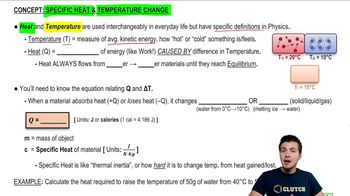
Specific Heat & Temperature Changes

Molar Mass

Molar mass is the mass of one mole of a substance, typically expressed in grams per mole (g/mol). It is essential for converting between the mass of a substance and the amount in moles, which is necessary for calculating specific heat capacities in terms of molar quantities. For nitrogen gas (N2), the molar mass is 28.0 g/mol, which helps in determining its specific heat.
추천 영상:
가이드 코스
20:32
Mass Spectrometers

Comparison of States of Matter

Comparing the specific heat of gases and liquids involves understanding the differences in molecular interactions and energy storage. Gases, like nitrogen, have molecules that are more free to move, while liquids, like water, have stronger intermolecular forces. This affects their specific heat values, with liquids generally having higher specific heat due to the energy required to overcome these forces.
추천 영상:
가이드 코스
06:27
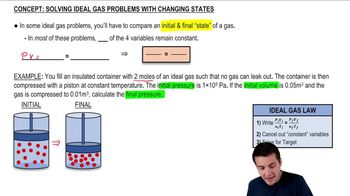
Solving Ideal Gas Problems With Changing States