

Ch 18: Thermal Properties of Matter
Young & Freedman Calc - University Physics 14th Edition
Young & Freedman Calc14th EditionUniversity PhysicsISBN: 9780321973610당신이 사용하는 게 아니라요?교과서 변경
18장, 문제 41c

For diatomic carbon dioxide gas (CO2, molar mass 44.044.0 g/mol) at T=300T = 300 K, calculate the root-mean-square speed vrmsv_{rms}.

검증된 단계별 안내
1
First, understand the concept of root-mean-square speed (v_rms). It is a measure of the average speed of particles in a gas and is derived from the kinetic theory of gases.
The formula for root-mean-square speed is given by: 3kTm, where k is the Boltzmann constant (1.38×10¯23 J K¯1), T is the temperature in Kelvin, and m is the mass of one molecule in kilograms.
Convert the molar mass of CO2 from grams per mole to kilograms per molecule. Use the conversion factor: 1 mol = 6.022×10¯23 molecules.
Calculate the mass of one CO2 molecule using the formula: molar massAvogadro number. This will give you the mass in kilograms.
Substitute the values for k, T, and m into the v_rms formula to find the root-mean-square speed of CO2 at 300 K.

비슷한 문제에 대한 검증된 영상 답변:

이 영상 해법은 위 문제에 도움이 된다고 튜터들이 추천한 것입니다.
영상 길이:
3m

주요 개념

질문에 올바르게 답하기 위해 반드시 이해해야 하는 핵심 개념들은 다음과 같습니다.

Root-Mean-Square Speed

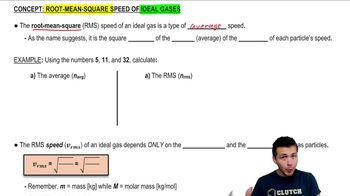
The root-mean-square speed (v_rms) is a measure of the average speed of particles in a gas, derived from the kinetic theory of gases. It is calculated using the formula v_rms = sqrt((3kT)/m), where k is the Boltzmann constant, T is the temperature in Kelvin, and m is the mass of a single molecule. This concept helps understand the distribution of molecular speeds in a gas.
추천 영상:
가이드 코스
05:21
Root-Mean-Square Speed of Ideal Gases

Kinetic Theory of Gases

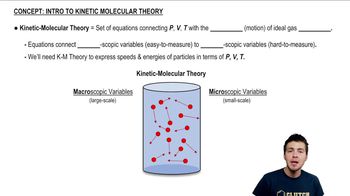
The kinetic theory of gases explains the macroscopic properties of gases by considering their molecular composition and motion. It assumes that gas molecules are in constant, random motion and that their collisions are perfectly elastic. This theory provides the basis for calculating properties like pressure, temperature, and speed, including the root-mean-square speed.
추천 영상:
가이드 코스
01:50
Introduction to Kinetic-Molecular Theory

Molar Mass and Molecular Mass

Molar mass is the mass of one mole of a substance, expressed in grams per mole (g/mol), and is crucial for converting between moles and grams. Molecular mass refers to the mass of a single molecule, typically expressed in atomic mass units (amu). For calculations involving gases, knowing the molar mass allows us to determine the mass of individual molecules, which is essential for computing the root-mean-square speed.
추천 영상:
가이드 코스
20:32
Mass Spectrometers
관련 실천
교과서 질문

The vapor pressure is the pressure of the vapor phase of a substance when it is in equilibrium with the solid or liquid phase of the substance. The relative humidity is the partial pressure of water vapor in the air divided by the vapor pressure of water at that same temperature, expressed as a percentage. The air is saturated when the humidity is 100%100\%. The vapor pressure of water at 20.020.0°C is 2.34×1032.34\(\times\)10^3 Pa. If the air temperature is 20.020.0°C and the relative humidity is 60%60\%, what is the partial pressure of water vapor in the atmosphere (that is, the pressure due to water vapor alone)?

3222
views
1
rank
교과서 질문

Solid water (ice) is slowly warmed from a very low temperature. What minimum external pressure p1p_1 must be applied to the solid if a melting phase transition is to be observed? Describe the sequence of phase transitions that occur if the applied pressure pp is such that p<p1p<p_1.

1012
views
교과서 질문

For diatomic carbon dioxide gas (CO2, molar mass 44.044.0 g/mol) at T=300T = 300 K, calculate the most probable speed vmpv_{mp}.

1963
views
1
rank
교과서 질문

For diatomic carbon dioxide gas (CO2, molar mass 44.044.0 g/mol) at T=300T = 300 K, calculate the average speed vavv_{av}.

1631
views
교과서 질문

Compute the specific heat at constant volume of nitrogen (N2) gas, and compare it with the specific heat of liquid water. The molar mass of N2 is 28.028.0 g/mol.

2605
views
교과서 질문

For a gas of nitrogen molecules (N2), what must the temperature be if 94.7%94.7\% of all the molecules have speeds less than 15001500 m/s? Use Table 18.218.2. The molar mass of N2 is 28.028.0 g/mol.

1870
views