
Ch 18: Thermal Properties of Matter
Young & Freedman Calc - University Physics 14th Edition
Young & Freedman Calc14th EditionUniversity PhysicsISBN: 9780321973610당신이 사용하는 게 아니라요?교과서 변경
18장, 문제 42a

For a gas of nitrogen molecules (N2), what must the temperature be if 94.7%94.7\% of all the molecules have speeds less than 15001500 m/s? Use Table 18.218.2. The molar mass of N2 is 28.028.0 g/mol.

검증된 단계별 안내
1
First, understand that the problem involves the Maxwell-Boltzmann distribution of molecular speeds in a gas. This distribution describes the probability of molecules having certain speeds at a given temperature.
Next, convert the molar mass of nitrogen (N2) from grams per mole to kilograms per mole. Since 1 gram = 0.001 kilograms, the molar mass of N2 is 28.0 g/mol, which is equivalent to 0.028 kg/mol.
Use the Maxwell-Boltzmann speed distribution formula to relate the fraction of molecules with speeds less than a given value to the temperature. The formula involves the most probable speed, which is given by: 2kTm, where k is the Boltzmann constant, T is the temperature, and m is the mass of a molecule.
Determine the fraction of molecules with speeds less than 1500 m/s using the cumulative distribution function (CDF) of the Maxwell-Boltzmann distribution. This involves integrating the probability density function up to the speed of 1500 m/s.
Finally, solve for the temperature T that corresponds to 94.7% of molecules having speeds less than 1500 m/s. This requires using the inverse of the CDF and the known values to find T.

비슷한 문제에 대한 검증된 영상 답변:

이 영상 해법은 위 문제에 도움이 된다고 튜터들이 추천한 것입니다.
영상 길이:
4m

주요 개념

질문에 올바르게 답하기 위해 반드시 이해해야 하는 핵심 개념들은 다음과 같습니다.

Maxwell-Boltzmann Distribution

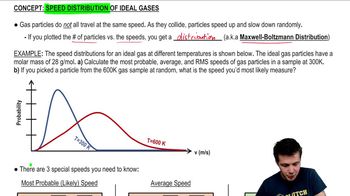
The Maxwell-Boltzmann distribution describes the distribution of speeds among molecules in a gas. It is crucial for understanding how molecular speeds vary with temperature. The distribution is characterized by a peak at the most probable speed, and the shape of the curve changes with temperature, affecting the fraction of molecules below a certain speed.
추천 영상:
가이드 코스
07:59
Speed Distribution & Special Speeds of Ideal Gases

Root Mean Square Speed

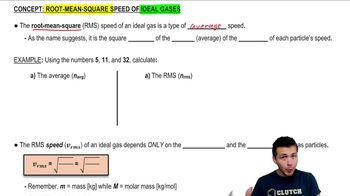
The root mean square (RMS) speed is a measure of the average speed of particles in a gas, derived from the Maxwell-Boltzmann distribution. It is calculated using the formula v_rms = sqrt(3kT/m), where k is the Boltzmann constant, T is the temperature, and m is the mass of a molecule. This concept helps relate temperature to molecular speed.
추천 영상:
가이드 코스
05:21
Root-Mean-Square Speed of Ideal Gases

Molar Mass and Molecular Speed

Molar mass is the mass of one mole of a substance, and it plays a critical role in determining the speed of gas molecules. For nitrogen (N2), the molar mass is 28.0 g/mol, which must be converted to kg for calculations. The molecular speed is inversely related to the molar mass, affecting how temperature influences the speed distribution of the molecules.
추천 영상:
가이드 코스
01:50
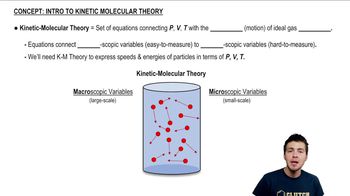
Introduction to Kinetic-Molecular Theory