
The vapor pressure is the pressure of the vapor phase of a substance when it is in equilibrium with the solid or liquid phase of the substance. The relative humidity is the partial pressure of water vapor in the air divided by the vapor pressure of water at that same temperature, expressed as a percentage. The air is saturated when the humidity is . The vapor pressure of water at °C is Pa. If the air temperature is °C and the relative humidity is , what is the partial pressure of water vapor in the atmosphere (that is, the pressure due to water vapor alone)?
Ch 18: Thermal Properties of Matter
18장, 문제 43a
Solid water (ice) is slowly warmed from a very low temperature. What minimum external pressure must be applied to the solid if a melting phase transition is to be observed? Describe the sequence of phase transitions that occur if the applied pressure is such that .
검증된 단계별 안내1
Understand the phase diagram of water: Water can exist in different phases (solid, liquid, gas) depending on temperature and pressure. The phase diagram shows the conditions under which each phase is stable.
Identify the melting point at standard pressure: At 1 atm pressure, ice melts at 0°C. However, the melting point can change with pressure.
Determine the pressure p1 for melting: The minimum external pressure p1 required for ice to melt can be found using the phase diagram. At pressures below p1, ice will not transition directly to liquid water upon heating.
Consider the sequence of phase transitions for p < p1: If the applied pressure is less than p1, ice will undergo sublimation, transitioning directly from solid to gas without passing through the liquid phase.
Use the Clausius-Clapeyron relation: This relation describes how the pressure and temperature at which phase transitions occur are related. It can be used to calculate the pressure p1 by considering the enthalpy and volume changes during the phase transition.

비슷한 문제에 대한 검증된 영상 답변:
이 영상 해법은 위 문제에 도움이 된다고 튜터들이 추천한 것입니다.
영상 길이:
3m도움이 되었나요?
주요 개념
질문에 올바르게 답하기 위해 반드시 이해해야 하는 핵심 개념들은 다음과 같습니다.
Phase Transitions
Phase transitions refer to the transformation of a substance from one state of matter to another, such as from solid to liquid. This process occurs when the temperature and pressure conditions reach specific thresholds, known as the melting point for solid to liquid transitions. Understanding these conditions is crucial for predicting the behavior of substances under varying external pressures.
추천 영상:
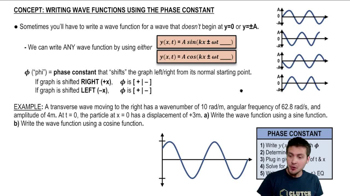
Phase Constant of a Wave Function
Pressure and Melting Point
The melting point of a substance can be influenced by external pressure. For ice, increasing pressure can lower the melting point, allowing it to transition to liquid at lower temperatures. The minimum external pressure required to observe a melting phase transition is determined by the substance's phase diagram, which maps the relationship between pressure, temperature, and state of matter.
추천 영상:
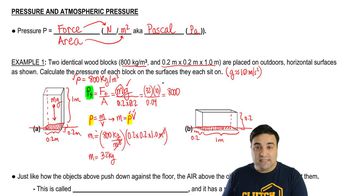
Pressure and Atmospheric Pressure
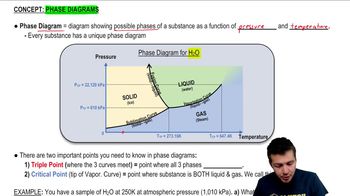
Phase Diagram
A phase diagram is a graphical representation that shows the conditions of temperature and pressure under which distinct phases of a substance exist. It helps in understanding the sequence of phase transitions, such as solid to liquid or liquid to gas, under varying pressures. For ice, the diagram indicates the pressure threshold p1 needed for melting, and the transitions that occur when p < p1.
추천 영상:
Phase Diagrams
관련 실천
교과서 질문
3221
views
1
rank
교과서 질문
For diatomic carbon dioxide gas (CO2, molar mass g/mol) at K, calculate the average speed .
1631
views
교과서 질문
For a gas of nitrogen molecules (N2), what must the temperature be if of all the molecules have speeds less than m/s? Use Table . The molar mass of N2 is g/mol.
1870
views
교과서 질문
For diatomic carbon dioxide gas (CO2, molar mass g/mol) at K, calculate the root-mean-square speed .
2080
views
