Ch 25: Current, Resistance, and EMF
Young & Freedman Calc - University Physics 14th Edition
Young & Freedman Calc14th EditionUniversity PhysicsISBN: 9780321973610당신이 사용하는 게 아니라요?교과서 변경
25장, 문제 22

A hollow aluminum cylinder is 2.502.50 m long and has an inner radius of 2.752.75 cm and an outer radius of 4.604.60 cm. Treat each surface (inner, outer, and the two end faces) as an equipotential surface. At room temperature, what will an ohmmeter read if it is connected between (a) the opposite faces and (b) the inner and outer surfaces?

검증된 단계별 안내
1
First, understand that the problem involves calculating the resistance of a hollow aluminum cylinder. The resistance can be calculated using the formula: R=ρLA, where ρ is the resistivity of aluminum, L is the length of the cylinder, and A is the cross-sectional area through which current flows.
For part (a), calculate the resistance between the opposite faces. The cross-sectional area A is the area of the annular ring formed by the outer and inner radii. Use the formula for the area of an annular ring: A=π(r2-r1), where r2 is the outer radius and r1 is the inner radius.
Substitute the values for the radii and length into the resistance formula for part (a). Convert the radii from centimeters to meters before substituting: R=ρ×2.50π((0.046)2-(0.0275)2).
For part (b), calculate the resistance between the inner and outer surfaces. Here, the current flows radially through the cylindrical shell. The resistance formula for radial flow is: R=ρ×Lπ×(r2-r1), where L is the length of the cylinder.
Substitute the values for the radii and length into the resistance formula for part (b). Again, ensure the radii are in meters: R=ρ×2.50π×(0.046-0.0275).

비슷한 문제에 대한 검증된 영상 답변:

이 영상 해법은 위 문제에 도움이 된다고 튜터들이 추천한 것입니다.
영상 길이:
11m
도움이 되었나요?

주요 개념

질문에 올바르게 답하기 위해 반드시 이해해야 하는 핵심 개념들은 다음과 같습니다.

Resistance in Cylindrical Conductors

The resistance of a cylindrical conductor depends on its length, cross-sectional area, and the material's resistivity. For a hollow cylinder, the cross-sectional area is the difference between the outer and inner areas. The formula R = ρL/A, where ρ is resistivity, L is length, and A is cross-sectional area, is used to calculate resistance.
추천 영상:
가이드 코스
07:43
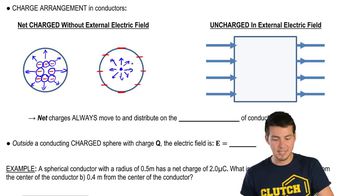
Electric Fields in Conductors

Equipotential Surfaces

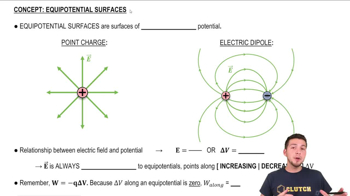
Equipotential surfaces are surfaces where the electric potential is constant. In this problem, the inner, outer, and end faces of the cylinder are equipotential, meaning no potential difference exists across these surfaces. This concept is crucial for understanding how current flows and how resistance is measured in different configurations.
추천 영상:
가이드 코스
09:18
Equipotential Surfaces

Ohm's Law

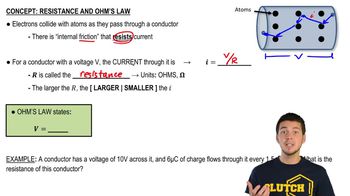
Ohm's Law states that the current through a conductor between two points is directly proportional to the voltage across the two points and inversely proportional to the resistance, expressed as V = IR. This principle is essential for determining the readings of an ohmmeter, which measures resistance by applying a known voltage and measuring the resulting current.
추천 영상:
가이드 코스
03:07
Resistance and Ohm's Law