
교과서 질문
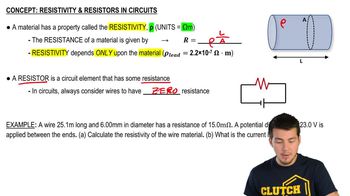
A copper transmission cable km long and cm in diameter carries a current of A. How much electrical energy is dissipated as thermal energy every hour?
2090
views

 검증된 단계별 안내
 05:25
05:25
 04:54
04:54 07:31
07:31A copper transmission cable km long and cm in diameter carries a current of A. How much electrical energy is dissipated as thermal energy every hour?
A hollow aluminum cylinder is m long and has an inner radius of cm and an outer radius of cm. Treat each surface (inner, outer, and the two end faces) as an equipotential surface. At room temperature, what will an ohmmeter read if it is connected between (a) the opposite faces and (b) the inner and outer surfaces?
A ductile metal wire has resistance . What will be the resistance of this wire in terms of if it is stretched to three times its original length, assuming that the density and resistivity of the material do not change when the wire is stretched? (Hint: The amount of metal does not change, so stretching out the wire will affect its cross-sectional area.)
An idealized ammeter is connected to a battery as shown in Fig. E. Find the reading of the ammeter.
In household wiring, copper wire mm in diameter is often used. Find the resistance of a -m length of this wire.
An idealized ammeter is connected to a battery as shown in Fig. E. Find the current through the - resistor.