
Ch 25: Current, Resistance, and EMF
Young & Freedman Calc - University Physics 14th Edition
Young & Freedman Calc14th EditionUniversity PhysicsISBN: 9780321973610당신이 사용하는 게 아니라요?교과서 변경
25장, 문제 46b

A typical small flashlight contains two batteries, each having an emf of 1.5 V, connected in series with a bulb having resistance 17 Ω. If the batteries last for 5.0 h, what is the total energy delivered to the bulb?

검증된 단계별 안내
1
First, understand that when batteries are connected in series, their emfs add up. Therefore, the total emf provided by the two batteries is 1.5 V + 1.5 V = 3.0 V.
Next, use Ohm's Law to find the current flowing through the circuit. Ohm's Law is given by: I=VR, where I is the current, V is the voltage, and R is the resistance. Substitute the values: I=3.017.
Calculate the power delivered to the bulb using the formula: P=IV, where P is the power, I is the current, and V is the voltage. Use the current calculated in the previous step and the total voltage of 3.0 V.
To find the total energy delivered to the bulb, use the formula: E=Pt, where E is the energy, P is the power, and t is the time. Substitute the power calculated in the previous step and the time of 5.0 hours, converting hours to seconds (1 hour = 3600 seconds).
Finally, perform the multiplication to find the total energy delivered to the bulb over the 5.0 hours. Remember to keep track of units and convert them appropriately to ensure the energy is in joules.

비슷한 문제에 대한 검증된 영상 답변:

이 영상 해법은 위 문제에 도움이 된다고 튜터들이 추천한 것입니다.
영상 길이:
5m
도움이 되었나요?

주요 개념

질문에 올바르게 답하기 위해 반드시 이해해야 하는 핵심 개념들은 다음과 같습니다.

Electromotive Force (EMF)

EMF is the voltage generated by a battery or power source when no current is flowing. It represents the energy provided per charge unit. In this question, each battery has an EMF of 1.5 V, and when connected in series, the total EMF is the sum of individual EMFs, resulting in 3.0 V.
추천 영상:

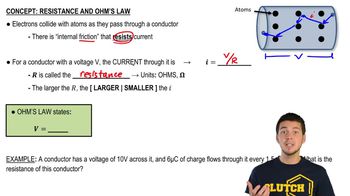
Ohm's Law

Ohm's Law states that the current through a conductor between two points is directly proportional to the voltage across the two points and inversely proportional to the resistance. It is expressed as I = V/R. For the flashlight, the current can be calculated using the total EMF (3.0 V) and the bulb's resistance (17 Ω).
추천 영상:
가이드 코스
03:07
Resistance and Ohm's Law

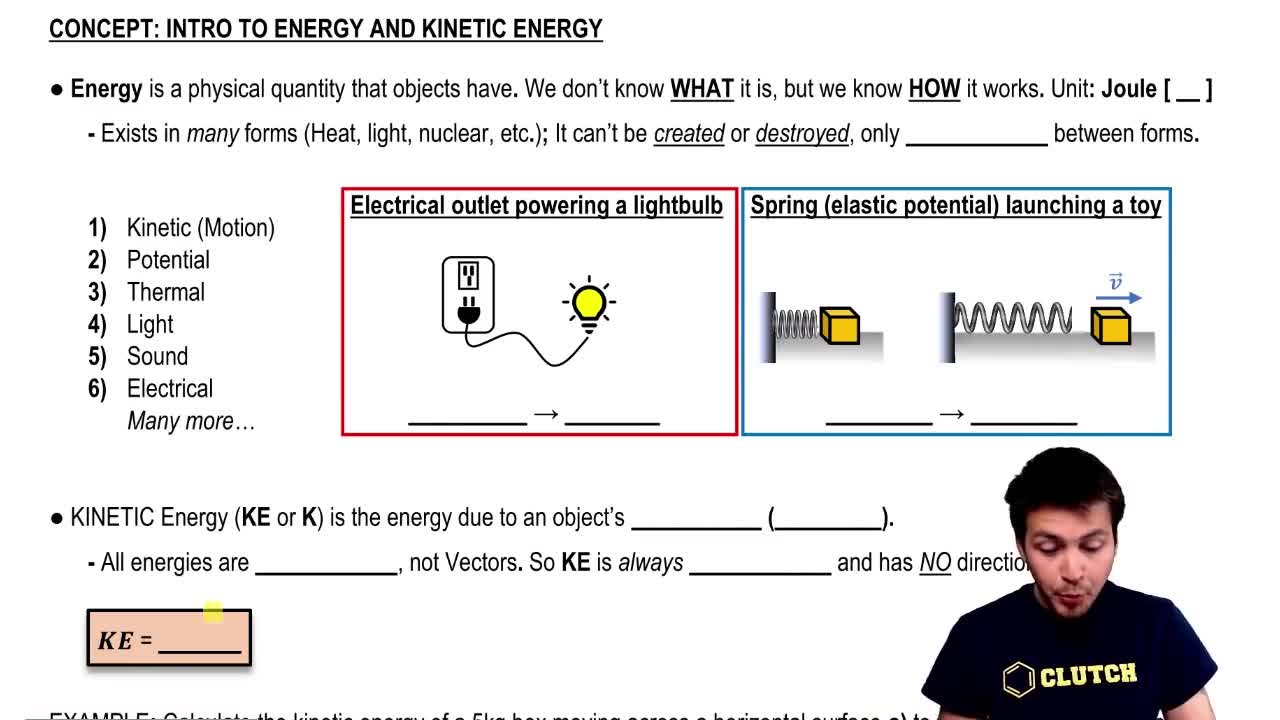
Energy Delivered

The energy delivered to a component in an electrical circuit is calculated using the formula E = P × t, where P is the power (P = V × I) and t is the time. In this scenario, the power can be determined using the total voltage and current, and the energy delivered over 5 hours can be calculated accordingly.
추천 영상:
가이드 코스
04:10
Intro to Energy & Types of Energy
관련 실천
교과서 질문

Pure silicon at room temperature contains approximately 1.0 × 10¹⁶ free electrons per cubic meter. (a) Referring to Table 25.1, calculate the mean free time t for silicon at room temperature. (b) Your answer in part (a) is much greater than the mean free time for copper given in Example 25.11. Why, then, does pure silicon have such a high resistivity compared to copper?

1773
views
교과서 질문

A heart defibrillator is used to enable the heart to start beating if it has stopped. This is done by passing a large current of 12 A through the body at 25 V for a very short time, usually about 3.0 ms. How much energy is transferred?

1930
views
교과서 질문

A typical small flashlight contains two batteries, each having an emf of 1.5 V, connected in series with a bulb having resistance 17 Ω. The resistance of real batteries increases as they run down. If the initial internal resistance is negligible, what is the combined internal resistance of both batteries when the power to the bulb has decreased to half its initial value?

195
views
교과서 질문

A typical small flashlight contains two batteries, each having an emf of 1.5 V, connected in series with a bulb having resistance 17 Ω. If the internal resistance of the batteries is negligible, what power is delivered to the bulb?

1994
views
교과서 질문

The battery for a certain cell phone is rated at 3.70 V. According to the manufacturer, it can produce 3.15 × 10⁴ J of electrical energy, enough for 5.25 h of operation, before needing to be recharged. Find the average current that this cell phone draws when turned on.

1888
views