Ch 25: Current, Resistance, and EMF
Young & Freedman Calc - University Physics 14th Edition
Young & Freedman Calc14th EditionUniversity PhysicsISBN: 9780321973610당신이 사용하는 게 아니라요?교과서 변경
25장, 문제 49

Pure silicon at room temperature contains approximately 1.0 × 10¹⁶ free electrons per cubic meter. (a) Referring to Table 25.1, calculate the mean free time t for silicon at room temperature. (b) Your answer in part (a) is much greater than the mean free time for copper given in Example 25.11. Why, then, does pure silicon have such a high resistivity compared to copper?

검증된 단계별 안내
1
Step 1: Understand the concept of mean free time (τ). It is the average time between collisions of electrons as they move through a material. This is related to the material's resistivity and electron mobility.
Step 2: Use the formula for mean free time τ, which is given by τ = (m * μ) / (e * n), where m is the electron mass, μ is the electron mobility, e is the electron charge, and n is the number of free electrons per unit volume.
Step 3: Refer to Table 25.1 to find the electron mobility (μ) for silicon at room temperature. This value is necessary to calculate τ using the formula from Step 2.
Step 4: Calculate τ using the values obtained: m = 9.11 * 10^-31 kg (electron mass), e = 1.6 * 10^-19 C (electron charge), n = 1.0 * 10^16 m^-3 (free electrons per cubic meter), and μ from Table 25.1.
Step 5: Discuss why pure silicon has higher resistivity compared to copper. Silicon is a semiconductor with fewer free electrons and lower electron mobility compared to metals like copper, which have a high density of free electrons and high mobility, leading to lower resistivity.

비슷한 문제에 대한 검증된 영상 답변:

이 영상 해법은 위 문제에 도움이 된다고 튜터들이 추천한 것입니다.
영상 길이:
9m
도움이 되었나요?

주요 개념

질문에 올바르게 답하기 위해 반드시 이해해야 하는 핵심 개념들은 다음과 같습니다.

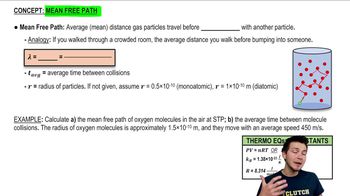
Mean Free Time

Mean free time is the average time between successive collisions of electrons as they move through a material. It is a crucial factor in determining the electrical conductivity of a material, as longer mean free times typically lead to higher conductivity. Calculating mean free time involves understanding the electron density and the scattering mechanisms within the material.
추천 영상:

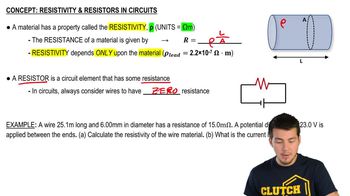
Resistivity

Resistivity is a measure of how strongly a material opposes the flow of electric current. It is influenced by factors such as electron mobility and density. Silicon's high resistivity compared to copper is due to its lower electron mobility and higher band gap, which restricts the flow of electrons, making it less conductive despite having a longer mean free time.
추천 영상:
가이드 코스
05:25
Resistivity & Resistors in Circuits

Band Gap

The band gap is the energy difference between the valence band and the conduction band in a semiconductor. It determines the number of charge carriers available for conduction. Silicon has a significant band gap, which limits the number of free electrons at room temperature, contributing to its higher resistivity compared to metals like copper, which have overlapping bands and more free electrons.
추천 영상:
가이드 코스
06:06
The Electromagnetic Spectrum