
Pure silicon at room temperature contains approximately 1.0 × 10¹⁶ free electrons per cubic meter. (a) Referring to Table 25.1, calculate the mean free time t for silicon at room temperature. (b) Your answer in part (a) is much greater than the mean free time for copper given in Example 25.11. Why, then, does pure silicon have such a high resistivity compared to copper?
Ch 25: Current, Resistance, and EMF
25장, 문제 46c
A typical small flashlight contains two batteries, each having an emf of 1.5 V, connected in series with a bulb having resistance 17 Ω. The resistance of real batteries increases as they run down. If the initial internal resistance is negligible, what is the combined internal resistance of both batteries when the power to the bulb has decreased to half its initial value?
검증된 단계별 안내1
Determine the initial power delivered to the bulb using the formula for power: , where is the total emf of the batteries and is the resistance of the bulb.
Express the total emf of the batteries as V, and substitute this value along with the bulb resistance Ω into the power formula to calculate the initial power.
When the power decreases to half its initial value, the new power is . Use the modified power formula , where is the combined internal resistance of the batteries, to relate the new power to the total resistance.
Set up the equation for the new power: . Substitute the known values for , , and into the equation.
Solve for the internal resistance by isolating it in the equation. Rearrange the terms to express in terms of the known quantities, and simplify the expression to find the combined internal resistance of the batteries.

비슷한 문제에 대한 검증된 영상 답변:
이 영상 해법은 위 문제에 도움이 된다고 튜터들이 추천한 것입니다.
도움이 되었나요?
주요 개념
질문에 올바르게 답하기 위해 반드시 이해해야 하는 핵심 개념들은 다음과 같습니다.
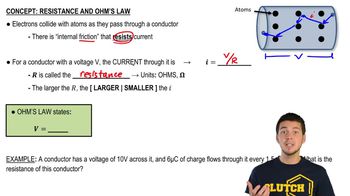
Ohm's Law
Ohm's Law states that the current (I) flowing through a conductor between two points is directly proportional to the voltage (V) across the two points and inversely proportional to the resistance (R) of the conductor. This relationship is expressed mathematically as V = IR. Understanding this law is crucial for analyzing circuits, as it helps determine how voltage, current, and resistance interact within the system.
추천 영상:
가이드 코스
Resistance and Ohm's Law
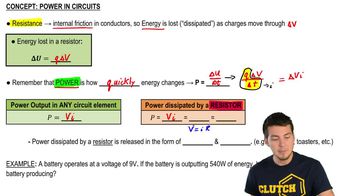
Power in Electrical Circuits
The power (P) consumed by an electrical device is defined as the rate at which energy is used or converted. In a circuit, power can be calculated using the formula P = IV, where I is the current and V is the voltage. Additionally, power can also be expressed in terms of resistance as P = I²R or P = V²/R. This concept is essential for understanding how changes in resistance or current affect the power delivered to components like bulbs.
추천 영상:
가이드 코스
Power in Circuits
Internal Resistance of Batteries
Internal resistance refers to the resistance within a battery that opposes the flow of current. As batteries discharge, their internal resistance can increase, affecting the voltage available to external circuits. In the context of the flashlight, the internal resistance of the batteries becomes significant when the power to the bulb decreases, as it impacts the overall voltage and current supplied to the bulb, ultimately influencing its brightness.
추천 영상:
가이드 코스
Total Internal Energy
관련 실천
교과서 질문
1773
views
교과서 질문
A typical small flashlight contains two batteries, each having an emf of 1.5 V, connected in series with a bulb having resistance 17 Ω. If the batteries last for 5.0 h, what is the total energy delivered to the bulb?
1679
views
교과서 질문
A typical small flashlight contains two batteries, each having an emf of 1.5 V, connected in series with a bulb having resistance 17 Ω. If the internal resistance of the batteries is negligible, what power is delivered to the bulb?
1994
views
교과서 질문
The battery for a certain cell phone is rated at 3.70 V. According to the manufacturer, it can produce 3.15 × 10⁴ J of electrical energy, enough for 5.25 h of operation, before needing to be recharged. Find the average current that this cell phone draws when turned on.
1888
views
