
Off to Europe! You plan to take your hair dryer to Europe, where the electrical outlets put out 240 V instead of the 120 V seen in the United States. The dryer puts out 1600 W at 120 V. What could you do to operate your dryer via the 240 V line in Europe?
Ch 31: Alternating Current
31장, 문제 34bc
Off to Europe! You plan to take your hair dryer to Europe, where the electrical outlets put out 240 V instead of the 120 V seen in the United States. The dryer puts out 1600 W at 120 V. (b) What current will your dryer draw from a European outlet? (c) What resistance will your dryer appear to have when operated at 240 V?
검증된 단계별 안내1
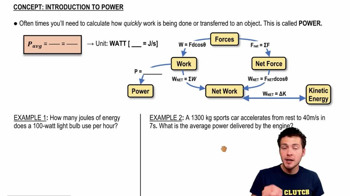
To find the current drawn by the dryer from a European outlet, we first need to understand the relationship between power, voltage, and current. The power (P) is given by the formula: P = V * I, where V is the voltage and I is the current.
Given that the dryer outputs 1600 W at 120 V, we can calculate the current it draws in the United States using the formula: I = P / V. Substitute the given values to find the current at 120 V.
Now, to find the current at 240 V, we assume the power output remains the same (1600 W). Use the formula I = P / V again, but this time substitute 240 V for the voltage.
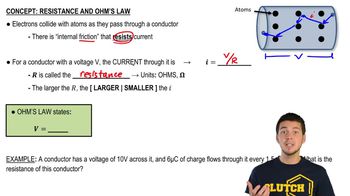
To find the resistance of the dryer when operated at 240 V, use Ohm's Law, which states that V = I * R, where R is the resistance. Rearrange this to find R: R = V / I.
Substitute the values for voltage (240 V) and the current calculated in the previous step into the formula R = V / I to find the resistance of the dryer when operated at 240 V.

비슷한 문제에 대한 검증된 영상 답변:
이 영상 해법은 위 문제에 도움이 된다고 튜터들이 추천한 것입니다.
영상 길이:
5m주요 개념
질문에 올바르게 답하기 위해 반드시 이해해야 하는 핵심 개념들은 다음과 같습니다.
Ohm's Law
Ohm's Law is a fundamental principle in physics that relates voltage (V), current (I), and resistance (R) in an electrical circuit. It is expressed as V = IR, meaning the voltage across a conductor is proportional to the current flowing through it, with the resistance being the constant of proportionality. This law is essential for calculating the current and resistance in circuits when voltage changes.
추천 영상:
가이드 코스
Resistance and Ohm's Law
Power Formula
The power formula in electrical circuits is given by P = VI, where P is the power in watts, V is the voltage in volts, and I is the current in amperes. This formula helps determine how much power an electrical device consumes or outputs, and is crucial for understanding how the hair dryer operates at different voltages, such as 120 V and 240 V.
추천 영상:
가이드 코스
Power
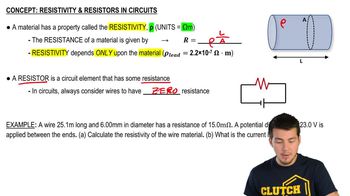
Resistance Calculation
Resistance in an electrical circuit can be calculated using the formula R = V/I, derived from Ohm's Law. It represents how much a device resists the flow of electric current. When the voltage changes, as in the case of using a hair dryer in Europe, recalculating resistance helps understand how the device will behave under different electrical conditions.
추천 영상:
가이드 코스
Resistivity & Resistors in Circuits
관련 실천
교과서 질문
1645
views
교과서 질문
A series ac circuit contains a 250-Ω resistor, a 15-mH inductor, a 3.5-μF capacitor, and an ac power source of voltage amplitude 45 V operating at an angular frequency of 360 rad/s.What is the power factor of this circuit?
1754
views
교과서 질문
An L-R-C series circuit is connected to a 120-Hz ac source that has Vrms = 80.0 V. The circuit has a resistance of 75.0 Ω and an impedance at this frequency of 105 Ω. What average power is delivered to the circuit by the source?
1791
views
교과서 질문
A Step-Down Transformer. A transformer connected to a 120 V (rms) ac line is to supply 12.0 V (rms) to a portable electronic device. The load resistance in the secondary is 5.00 Ω. What should the ratio of primary to secondary turns of the transformer be?
1709
views
